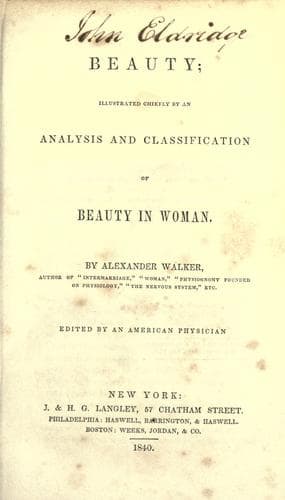
Beauty: Illustrated Chiefly by an Analysis and Classification of Beauty in WomanWalker, Alexander
Philosophy
Beauty: Illustrated Chiefly by an Analysis and Classification of Beauty in Woman
Walker, Alexander
Beauty, Personal; Women
Those who have the lower posterior part of the body too flat, elevate it
by the top of the skirt being gathered behind, and by other less skilful
adjustments, which though hid, are easily detected.
Those who have the lower part of the body too prominent anteriorly,
render it less apparent by shortening the waist, by a corresponding
projection behind, and by increasing the bosom above.
Those who have the haunches too narrow, take care not to have the bottom
of the dress too wide.
Tall women have a wide skirt, or several flounces, or both of these:
shorter women, a moderate one, but as long as can be conveniently worn,
with the flounces, &c., as low as possible.[57]
_External Indications of Beauty._
Additional indications as to beauty are required chiefly where the woman
observed precedes the observer, and may, by her figure, naturally and
reasonably excite his interest, while at the same time it would be rude to
turn and look in her face on passing.
There can, therefore, be no impropriety in observing, that the conduct of
those who may happen to meet the woman thus preceding, will differ
according to the sex of the person who meets her.--If the person meeting
her be a man, and the lady observed be beautiful, he will not only look
with an expression of pleasure at her countenance, but will afterward turn
more or less completely to survey her from behind.--If the person meeting
her be a woman, the case becomes more complex. If both be either ugly or
beautiful, or if the person meeting her be beautiful and the lady observed
be ugly, then it is probable, that the approaching person may pass by
inattentively, casting merely an indifferent glance: if, on the contrary,
the woman meeting her be ugly, and the lady observed be beautiful, then
the former will examine the latter with the severest scrutiny, and if she
sees features and shape without defect, she will instantly fix her eyes on
the head-dress or gown, in order to find some object for censure of the
beautiful woman, and for consolation in her own ugliness.
Thus he who happens to follow a female may be aided in determining whether
it is worth his while to glance at her face in passing, or to devise other
means of seeing it.
Even when the face is seen, as in meeting in the streets or elsewhere,
infinite deception occurs as to the degree of beauty. This operates so
powerfully, that a correct estimate of beauty is perhaps never formed at
first. This depends on the forms and still more on the colors of dress in
relation to the face. For this reason, it is necessary to understand the
principles according to which colors are employed at least by skilful
women.[58]
When it is the fault of a face to contain too much yellow, then yellow
around the face is used to remove it by contrast, and to cause the red and
blue to predominate.
When it is the fault of a face to contain too much red, then red around
the face is used to remove it by contrast, and to cause the yellow and
blue to predominate.
Public-domain text, read in full here on John Shaqi.
Reviews
Reviews
No reviews yet
Be the first to share your thoughts on this work.
Elsewhere in the archive
Join the Discussion
Join the discussion
Sign in to leave a comment or review.
Sign InorCreate an account