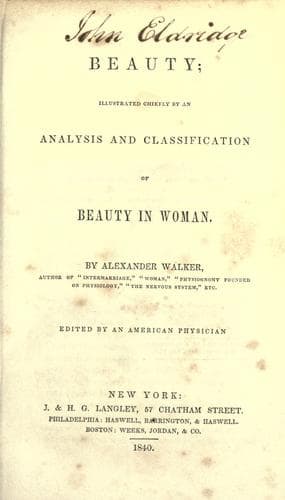
Beauty: Illustrated Chiefly by an Analysis and Classification of Beauty in WomanWalker, Alexander
Philosophy
Beauty: Illustrated Chiefly by an Analysis and Classification of Beauty in Woman
Walker, Alexander
Beauty, Personal; Women
Mr. Walker's extravagant admiration of the Grecian mythology has led him
to over-estimate its influence upon poetry and the arts. That these were
influenced, in a very important degree, by the religion of Greece, no one
acquainted with the history of that nation, can doubt; but, that the arts
cannot exist where the Grecian mythology is not the popular religion, is
an opinion unsupported by the history of the past, and altogether opposed
to their present flourishing state in civilized countries. In no age or
nation has the art of painting, for example, attained higher perfection,
than in Italy during the 13th and 14th centuries; a period which has been
called "the golden age of Italian art," and its high excellence has been
justly attributed to the introduction of Christianity. "The walls and
cupolas," says a late writer, "of new and splendid churches were
immediately covered, as if by enchantment, with the miracles of paintings
and sculpture--the eager multitude were not compelled to wait till genius
had labored for years on what it had been years in conceiving. Those eager
spirits seemed to breathe out their creations in full and mature
beauty--performing at once, by the buoyant energies of well-disciplined
genius, more than all the cold precision of mechanical knowledge can ever
accomplish." Allan Cunningham, in his life of Flaxman, the artist,
speaking of these paintings, remarks: "Into these Flaxman looked with the
eye of a sculptor and of a Christian. He saw, he said, that the mistress
to whom the great artists of Italy had dedicated their genius was the
Church; that they were unto her as chief priests, to interpret her tenets
and her legends to the world in a more brilliant language than that of
relics and images. To her illiterate people, the Church addressed herself
through the eye, and led their senses captive by the external
magnificence with which she overwhelmed them."
But it is unnecessary to multiply quotations to prove this point. Flaxman
never uttered a truer saying, than when he remarked, that "the Christian
religion presents personages and subjects no less favorable to painting
and sculpture than the ancient classics." Accordingly, we find among his
own immortal productions, that the monument erected in memory of Miss
Lushington, in Kent, representing a mother mourning for her daughter,
comforted by a ministering angel, was inspired by that text of holy writ,
"Blessed are they that mourn;" and the monument in memory of the family of
Sir Francis Baring imbodies these words, "Thy will be done--thy kingdom
come--deliver us from evil." To the first motto belongs a devotional
figure as large as life--
"Her looks communing with the skies;"
Public-domain text, read in full here on John Shaqi.
Reviews
Reviews
No reviews yet
Be the first to share your thoughts on this work.
Elsewhere in the archive
Join the Discussion
Join the discussion
Sign in to leave a comment or review.
Sign InorCreate an account