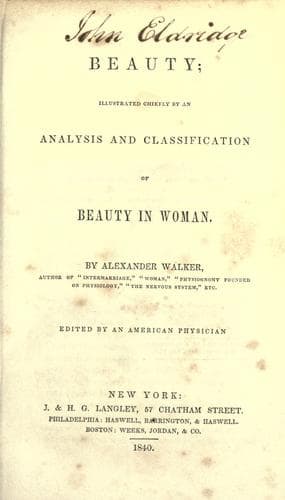
Beauty: Illustrated Chiefly by an Analysis and Classification of Beauty in WomanWalker, Alexander
Philosophy
Beauty: Illustrated Chiefly by an Analysis and Classification of Beauty in Woman
Walker, Alexander
Beauty, Personal; Women
a perfect image of piety and resignation. On one side, imbodying "Thy
kingdom come," a mother and daughter ascend to the skies welcomed rather
than supported by angels; and on the other, expressing the sentiment
"Deliver us from evil," a male figure, in subdued agony, appears in the
air, while spirits of good and evil contend for the mastery. This has been
considered one of the finest pieces of motionless poetry in England. We
hold, then, that Mr. Walker's remark that "neither poetry nor the arts can
have being, without the religion of Greece," is far from being sustained,
either by history or observation.
B.
The remarks of Mr. Walker, in relation to the duty of parents and
teachers, seem to us well-founded and judicious. If moral, as well as
intellectual and physical education, be part of the parental duty, then it
would seem to follow, that it should embrace those subjects which are of
the most importance, both to the physical and moral well-being of the
child; and surely, the relation of the sexes, and the due subjection of
the animal propensities, are not the least important of these. There is a
delicacy generally felt and observed on this point, which springs from a
principle that we honor and respect, while, at the same time, we doubt
whether it leads to favorable and auspicious results. No one, who looks
back upon the years of his own childhood, can for a moment doubt that
judicious advice and seasonable information on certain subjects, which
were probably considered of a too delicate nature to be even hinted at,
would have been highly useful. The young will inevitably become initiated
into certain vices and evil practices, unless put on their guard, by the
warning voice of those they love and respect. There are a variety of
passions, affections, and appetites, which belong to our nature, and were
intended when properly directed and indulged, to promote our interest and
happiness. Those under consideration, early begin to manifest themselves,
and, when left without the restraints of enlightened intellect and the
moral sense, invariably lead to disastrous consequences. The question then
is, shall the young and inexperienced be left to the mere accidents of its
condition, without an effort to give it sound principles to govern it, or
without bringing some conservative influence to bear upon it? We think,
with Mr. Walker, that it should not. Both philosophy and reason prove the
danger of such a course. The circumstances which are connected with sexual
vices cannot be wholly kept out of view. They meet the eye, or are
suggested to the imagination, at almost every turn. A thousand scenes and
incidents occur to excite the passions, if the mind is not fortified
against their influence. Those who are fastidious, and believe that
delicacy forbids all allusion to such subjects, will say, "Keep the youth
in ignorance--conceal, if possible, everything from his view, that may
excite the passions." Still, there remain the constitutional
Public-domain text, read in full here on John Shaqi.
Reviews
Reviews
No reviews yet
Be the first to share your thoughts on this work.
Elsewhere in the archive
Join the Discussion
Join the discussion
Sign in to leave a comment or review.
Sign InorCreate an account