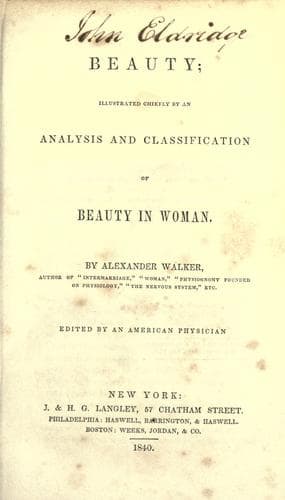
Beauty: Illustrated Chiefly by an Analysis and Classification of Beauty in WomanWalker, Alexander
Philosophy
Beauty: Illustrated Chiefly by an Analysis and Classification of Beauty in Woman
Walker, Alexander
Beauty, Personal; Women
It is observed by Home, in his "Elements of Criticism," that a perception
of beauty in external objects is requisite to attach us to them; that it
greatly promotes industry, by promoting a desire to possess things that
are beautiful; and that it farther joins with utility, in prompting us to
embellish our houses and enrich our fields. "These, however," he says,
"are but slight effects, compared with the connexions which are formed
among individuals in society by means of this singular mechanism: the
qualifications of the head and heart are undoubtedly the most solid and
most permanent foundations of such connexions; but as external beauty lies
more in view, and is more obvious to the bulk of mankind, than the
qualities now mentioned, the sense of beauty possesses the more universal
influence in forming these connexions; at any rate, it concurs in an
eminent degree, with mental qualifications, to produce social
intercourse, mutual good-will, and, consequently, mutual aid and support,
which are the life of society."
Dr. Pritchard similarly observes, that "the perception of beauty is the
chief principle in every country which directs men in their marriages."
Advancing a step farther, Sir Anthony Carlisle thinks a taste for beauty
worthy of being cultivated. "Man," he observes, "dwells with felicity even
on ideal female attributes, and in imagination discovers beauties and
perfections which solace his wearied hours, far beyond any other resource
within the scope of human life. It cannot, then, be unwise to cultivate
and refine this natural tendency, and to enhance, if possible, these
charms of life. We increase and heighten all our pleasures by awakening
and cultivating reflections which do not exist in a state of ignorance.
Thus, the botanist perceives elegances in plants and flowers unknown and
unfelt by the vulgar, and the landscape-painter revels in natural or
imaginary scenery, with feelings which are unknown to the multitude. It
would be absurd to pretend that the more exquisite and more deeply
attractive beauty of woman is not worthy of more profound, as well as more
universal cultivation."
Such are the observations of philosophical anthropologists, who,
nevertheless, in these remarks, consider mere physical beauty independent
of its connexion with corresponding functions or moral qualities.
If, however, the external beauty of woman, calculated as it is to flatter
the most experienced eye, limited its effect to a local impression, to an
optical enjoyment, the sentiment of beauty would be far from having all
its extent and value. Happily, ideas of goodness, of suitableness, of
sympathy, of progressive perfection, and of mutual happiness, are, by an
intimate and inevitable association, connected with the first impression
made by the sight of beauty.
The foundation of this feeling is well expressed by Dr. Pritchard, in his
observation that "the idea of beauty of person is synonymous with that of
health and perfect organization."
Public-domain text, read in full here on John Shaqi.
Reviews
Reviews
No reviews yet
Be the first to share your thoughts on this work.
Join the Discussion
Join the discussion
Sign in to leave a comment or review.
Sign InorCreate an account