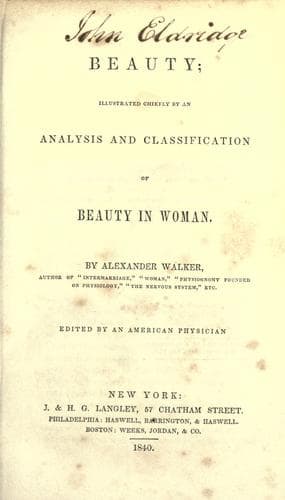
Beauty: Illustrated Chiefly by an Analysis and Classification of Beauty in WomanWalker, Alexander
Philosophy
Beauty: Illustrated Chiefly by an Analysis and Classification of Beauty in Woman
Walker, Alexander
Beauty, Personal; Women
"I shall offer what I believe to be an original and satisfactory
explanation of the beauty of form, on principles purely physiological. It
is based on the proposition, that the action of every muscle is attended
with a sensation which, is at first agreeable, but which, if the action is
continued for a short time with intensity, and without intermission,
becomes painful. That there is pleasure attending those varied motions
which depend upon the actions of different muscles in succession after
intervals of rest in each, we know from our own consciousness as well as
from that instinctive propensity to play which we observe in children and
young animals. That the prolonged action of a muscle is painful, we may
readily convince ourselves by endeavoring to hold the arm for some time at
right angles with the erect trunk. With the arm in this position, a pound
weight on the hand or even the weight of the arm itself becomes in a few
minutes almost insupportable. We presently begin to feel pain in the
shoulder and anterior part of the arm, the former from fatigue of those
muscles which originate from the scapula and keep the os humeri elevated,
and the latter from fatigue of the muscles which originate from the
scapula and os humeri, whose muscular fibres are in front of the os humeri
and by their contraction elevate the fore-arm in consequence of their
tendinous attachment to its bones. Yet a man may labor all day with his
arms without this painful sensation; because a muscle requires but a
momentary rest, in order to regain that degree of energy which is
momentarily lost by action.
"None but an anatomist can duly appreciate the variety of separate
actions, on which depend the motions of a single limb, and the
consequently numerous opportunities of rest which the muscles enjoy. To
the superficial and unscientific observer, an arm is an arm; it is a
single member which may be fatigued by a day's work and recruited by a
night's rest. But to the anatomist the arm is a complex object, and its
muscular energy is that of its component muscles, each of which may be
fatigued by a minute's action and recruited by a minute's repose. It would
be easy to extend this farther, and state reasons for believing that the
component fasciculi and fibres of an individual muscle act still more
transiently, and that their momentary and successive actions constitute
the action of a single muscle.
Public-domain text, read in full here on John Shaqi.
Reviews
Reviews
No reviews yet
Be the first to share your thoughts on this work.
Elsewhere in the archive
Join the Discussion
Join the discussion
Sign in to leave a comment or review.
Sign InorCreate an account