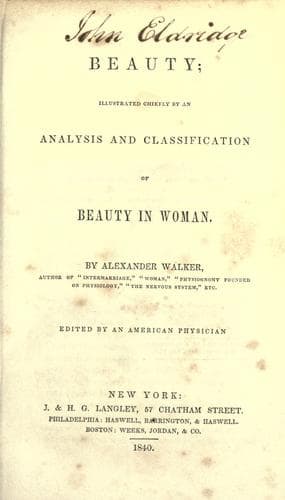
Beauty: Illustrated Chiefly by an Analysis and Classification of Beauty in WomanWalker, Alexander
Philosophy
Beauty: Illustrated Chiefly by an Analysis and Classification of Beauty in Woman
Walker, Alexander
Beauty, Personal; Women
As preparatory to the consideration of the beauty of form, it will be
necessary to give an explanation of the _gracefulness of motion_. Although
this has been vaguely and in part referred to ease of execution, yet, the
physiological principle on which ease of execution depends, not having
been clearly understood and distinctly stated, the gracefulness of _all_
motions could not be referred to their true source. Thus, writers on taste
have been under the necessity of admitting, as a distinct and independent
source of gracefulness, the _curvilinear direction_ of motions, and have
been able to generalize this fact no farther than by referring it to the
beauty of curved forms, which beauty was considered an _ultimate_ fact. In
applying the principles above developed, to the explanation of the
pleasure or pain attending the contemplation of particular motions, we
shall defer for the present the investigation of the intrinsic beauty of
curved motions, which is the same as that of curved lines, and assume that
in general those motions which are physically pleasurable to the agent are
agreeable to the observer. The pleasure or pain of the agent will engage
the sympathy of the observer; for he associates the observed action with
his own experience. To make a single application, suppose a public speaker
extend his arm horizontally and move it slowly in a horizontal position,
through one third of a circle. This motion would not appear graceful. That
it would not be performed with perfect ease, any one might prove by
experiment. The principal difficulty is in preserving for a long time the
horizontal position."
"In the ordinary state of the muscular system, and within certain limits,
the motion of the eye in any direction is pleasurable. Whenever the power
of directing the eye is acquired, the tracing of a line will, to a certain
extent and for a certain time, afford some degree of positive pleasure; in
other words, any short line will possess some degree of positive beauty,
and the infant becomes conscious of an emotion of which he was previously
ignorant--the emotion of beauty of form. A point awakens no such emotion;
it never will; it can possess no beauty. It must be recollected, that this
has been restricted to minute points of inappreciable form. Circular dots
will be considered under the head of figures. The colorific property of a
dot as compared with that of the ground on which it is placed, may afford
that kind of ocular pleasure which is foreign to the present inquiry.
"From points as compared with lines, we naturally proceed to _lines as
compared with each other_.
Public-domain text, read in full here on John Shaqi.
Reviews
Reviews
No reviews yet
Be the first to share your thoughts on this work.
Elsewhere in the archive
Join the Discussion
Join the discussion
Sign in to leave a comment or review.
Sign InorCreate an account