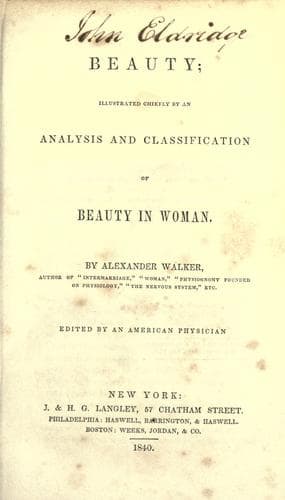
Beauty: Illustrated Chiefly by an Analysis and Classification of Beauty in WomanWalker, Alexander
Philosophy
Beauty: Illustrated Chiefly by an Analysis and Classification of Beauty in Woman
Walker, Alexander
Beauty, Personal; Women
Dr. C. afterward goes on to prove that no single nerve, or organ, can
perform two distinct functions, but that each is capable of one mode of
action, and no more; that between a nerve, a muscle, and a gland, the only
difference known to exist, is that of organization; and that if they are
organized alike, and endowed with life, their properties will be similar,
and they will act in the same way. So also between animals of the same
race, we discover innumerable differences, which can be referred to
nothing but differences in organization, and the same may be affirmed of
vegetables. The conclusion to which Dr. C. arrives, and which he maintains
with great ingenuity is, that independently of all other causes,
differences in human temperament are to be attributed, in part, to
corresponding differences in the organization of certain portions, or the
whole of the body; and that, other things being equal, in consequence of
this source of influence alone, one person differs from another in many of
the qualities of both person and intellect. In other words, he is more
highly gifted, sprightly, and vigorous, or the reverse; or he is more
courageous or timid, generous or selfish, according to his organization.
"But the second cause that was represented to be instrumental in
diversifying the human temperaments is by far the most powerful. It will
be remembered to have been, 'difference of size and vigor in certain
ruling organs of the system.' The organs alluded to are those contained in
the three great cavities of the body; the chylopoetic, situated in the
abdomen, and including the stomach and intestines, with the liver,
pancreas, mesentery, and lacteals; those of sanguification and
circulation, situated in the thorax, and consisting of the lungs, heart,
and bloodvessels; and the brain, with its appendages, the spinal cord and
nerves. These three _groups_ (for the brain is _multiplex_ as well as the
other two) are not only the ruling organs in the person of man; connected
with the hard and soft parts that enclose them, they _constitute the
person_. The upper and lower extremities are but appendages; important and
necessary, it must be acknowledged; but still appendages. The individual
can exist and be a human being without them. Nor have they any influence
in imparting constitutional character to their possessors. Standing only
in the capacity of subordinates to the controlling organs, they are not
only nourished and put in motion by them; they labor mechanically for
their uses, and serve as instruments to execute their purposes. They are
composed of the extreme ends of the organized matter of the system,
constitute only its outworks, and possess but little influence over its
central parts. This representation rests on evidence that may be termed
demonstrative. Many persons destitute of the upper or lower extremities,
or both, have strong characters and well-marked temperaments. But the
Public-domain text, read in full here on John Shaqi.
Reviews
Reviews
No reviews yet
Be the first to share your thoughts on this work.
Elsewhere in the archive
Join the Discussion
Join the discussion
Sign in to leave a comment or review.
Sign InorCreate an account