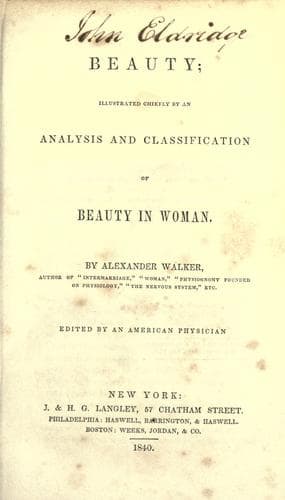
Beauty: Illustrated Chiefly by an Analysis and Classification of Beauty in WomanWalker, Alexander
Philosophy
Beauty: Illustrated Chiefly by an Analysis and Classification of Beauty in Woman
Walker, Alexander
Beauty, Personal; Women
extremities, if deprived of the influence of any one group of the ruling
organs, are converted not only into useless but lifeless masses. Of the
skin, muscles, and bones, which compose the head, neck, and trunk of the
body, the same is true. Of themselves they possess no character, and can
therefore bestow none. They also are but appendages to the organs they
cover, affording them a secure lodgment and protection from external
injuries, and aiding them in the performance of some of their functions.
And from this alone is their importance derived. Were it possible for them
to exist apart from the viscera they contain, their grade of being would
be below that of many vegetables. Most fatal diseases, moreover, have
their original seat in the viscera of one of the three great cavities of
the body, and no disease originating elsewhere can become fatal, until, by
sympathy or metastasis, some of those parts are deeply affected. To
enlightened physiologists this statement presents but a series of familiar
truths. To the groups of organs exclusively, then, I repeat, contained in
the abdomen, the thorax, and the cranium, must we look as the main source
of human character. And that character is different according to the
predominance, in different individuals, of one group or another, or of any
two of them. An equilibrium between the three groups constitutes another
variety, by bestowing on character a corresponding equilibrium. Let the
word _temperament_ be substituted for 'character,' and what is true of the
latter will be so of the former. As already mentioned, the organs referred
to will be its source; and the differences in their predominance will give
diversity to it."
Dr. C. then shows that the strength and perfection of each of the senses
are proportioned to the size of the nerve on which that sense depends.
This is illustrated by a powerful array of facts, drawn from different
orders of the animal kingdom, as well as from the different varieties of
mankind. It is also stated, that where any nerve or set of nerves, is
peculiarly large, the portion of the brain to which they belong, and by
which they are influenced and commanded, is correspondingly large.
"Inasmuch, then, as, other things being equal, size gives power to
everything else, we are not only justified in believing, on grounds of
analogy we are compelled to believe, that the same is true of the organs
contained in the cranium, the thorax, and the abdomen. When they are in a
sound and natural condition, their size is also the measure of their
power. Were not this the case, they would be either altogether abnormal,
or subject to laws that govern no other kind of matter, whether organic or
inorganic, of which we have any knowledge. But the position I am
contending for is not to be regarded as a mere inference in a process of
reasoning. It will appear hereafter that it is a positive fact, which
observation has discovered, and continues to confirm.
Public-domain text, read in full here on John Shaqi.
Reviews
Reviews
No reviews yet
Be the first to share your thoughts on this work.
Elsewhere in the archive
Join the Discussion
Join the discussion
Sign in to leave a comment or review.
Sign InorCreate an account