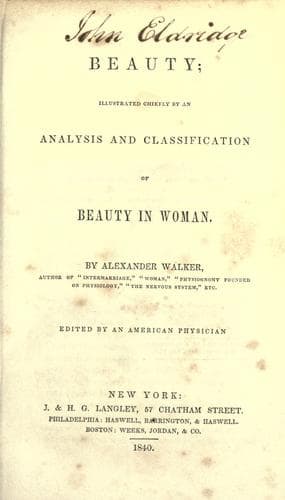
Beauty: Illustrated Chiefly by an Analysis and Classification of Beauty in WomanWalker, Alexander
Philosophy
Beauty: Illustrated Chiefly by an Analysis and Classification of Beauty in Woman
Walker, Alexander
Beauty, Personal; Women
True it is, that, whenever physical or moral principles are personified,
the ignorant may be led to mistake the sign for that which is signified;
but one of the most admirable characteristics of the Grecian religion is,
that, with little effort, every external form may be traced to the spirit
which it represents, and every fable may be resolved into a beautiful
illustration of physical or moral truth. So that when mystic influences,
with increasing knowledge, ceased to sway the imagination, all-powerful
truths directed the reason.
The natural and poetical religion of Greece, therefore, differed from
false and vulgar religions in this, that it was calculated to hold equal
empire over the minds of the ignorant and the wise; and the initiations of
Eleusis were apparently the solemn acts by which the youths and maidens of
Greece passed from ignorance and blind obedience to knowledge and
enlightened zeal. Thus, in that happy region, neither were the priests
knaves, nor the people their dupes.[5]
And what has been the result of this fundamental excellence?--that no
interpolated fooleries have been able to destroy it;--that the religion of
Greece exists, and must ever exist, the religion of nature, genius, and
taste;--and that neither poetry nor the arts can have being without it.
Schiller has well expressed this truth in the following lines:--
"The intelligible forms of ancient poets,
The fair humanities of old religion,
The power, the beauty, and the majesty,
That had their haunts in dale, or piny mountains,
Or forest, by slow stream, or pebbly spring,
Or chasms, and watery depths--all these have vanished;
They live no longer in the faith of reason;
But still the heart doth need a language; still
Doth the old instinct bring back the old names;
* * And even, at this day,
'Tis Jupiter who brings whate'er is great,
And Venus who brings everything that's fair."
CHAPTER III.
CAUTIONS AS TO YOUTH.
In relation to _early_ sexual association, it cannot be doubted, that,
when the instinct of reproduction begins to be developed, the reserve
which parents, relatives, and instructers, adopt on this subject, is often
the means of producing injurious effects; because, a system of concealment
on this subject, as observed in the preceding chapter, is quite
impracticable. Discoveries made by young persons in obscene books, the
unguarded language or shameless conduct of grown-up persons, even the wild
flights of an imagination which is then easily excited, will have the most
fatal consequences.
Public-domain text, read in full here on John Shaqi.
Reviews
Reviews
No reviews yet
Be the first to share your thoughts on this work.
Join the Discussion
Join the discussion
Sign in to leave a comment or review.
Sign InorCreate an account