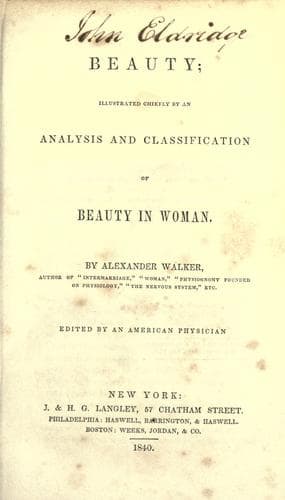
Beauty: Illustrated Chiefly by an Analysis and Classification of Beauty in WomanWalker, Alexander
Philosophy
Beauty: Illustrated Chiefly by an Analysis and Classification of Beauty in Woman
Walker, Alexander
Beauty, Personal; Women
In regard to stature, the body appears to complete its increase in height
chiefly at the age of puberty, and during the first years which succeed
that age. To be assured of the powerful influence of his own conduct, at
this period, upon his stature, the youth has only to compare the tall men
and women of the country as in Yorkshire, Lancashire, Westmoreland,
Cumberland, and the Scottish borders, where they have not been overworked,
with the stunted and dwarfed creatures of the metropolis, where a
stranger, when he first enters it, is apt to think he sees so many ugly
boys and girls, whereas, they are full-grown London men and women. Half
the population of the metropolis is affected in this way; and it is the
obvious consequence of the acceleration of puberty by confinement,
stimulating food, indecent plays, and sexual association.
In regard to the perfect development and beauty of the figure, the youth
is probably aware that the most beautiful races of horses and dogs rapidly
deteriorate, if men do not carefully maintain them by continence as well
as by crossing. The too early employment, the depraved abuses, the injury,
or the removal, of the sexual organs, are all of them causes still more
certain of deformity. The latter of these causes acts, of course, most
obviously; and it is evidenced in the almost universal malformation of
eunuchs, geldings, &c.
That, in regard to bodily strength, sexual continence adds energy to the
muscular fibre, is clearly seen by observing the most ardent quadrupeds
previous to the time of the union of their sexes. But, this being past,
precisely in the same proportion does the act of reproduction debilitate
and break down the strongest animal. Many male animals even fall almost
exhausted by a single act of union with the opposite sex.
Every classical student has read the beautiful allegory of Hercules, who,
having spun at the knees of Omphale ([Greek: omphalos] the navel, here put
for the most essential part of the female generative organ), thereby lost
his strength: this beautifully expresses the abasement of power amid the
indulgences of love. Euripides also depicts the terrible Achilles as timid
before women, and respectful with Clytemnestra and Iphigenia. Hence, when
a foolish lord reproached the poet Dryden with having given too much
timidity toward women to a personage in one of his tragedies, and added
that he knew better how to employ his time with the ladies, the poet
answered: "You now acknowledge that you are no hero, which I intended that
personage to be."
Public-domain text, read in full here on John Shaqi.
Reviews
Reviews
No reviews yet
Be the first to share your thoughts on this work.
Join the Discussion
Join the discussion
Sign in to leave a comment or review.
Sign InorCreate an account