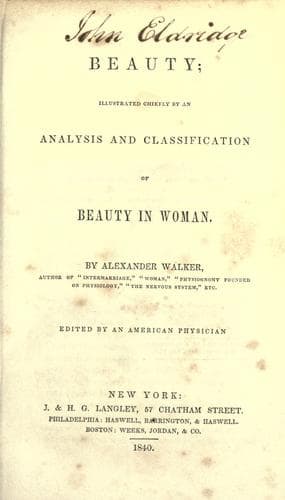
Beauty: Illustrated Chiefly by an Analysis and Classification of Beauty in WomanWalker, Alexander
Philosophy
Beauty: Illustrated Chiefly by an Analysis and Classification of Beauty in Woman
Walker, Alexander
Beauty, Personal; Women
While writing this, Sir Anthony Carlisle observes to me, that, "the
special disease which appears to be a punishment for sexual profligacy, is
not only malignant, painful, and hideous, in every stage of it, but the
only remedy known for its cure, mercury, is a poison which generally
leaves its own evils for the venom which it destroys. This frightful
disease has no natural termination but in a disgusting disgraceful death,
after disfiguring the countenance, by causing blindness, loss of the nose,
the palate and teeth, and by the spoliation of the sinning organs. The
miserables, who thus perish in public hospitals, are so offensive to the
more respectable patients, that they are confined to appointed rooms,
termed foul wards, where they linger and die in the bloom of life, either
of the penalty inflicted by their profligacy, of the poison administered
to them, or of incurable consequent diseases, such as consumption, palsy,
or madness."
Hence, it has been observed, that, if we have to deal with a young man
incapable of guidance by the nobler motives, of feeling contempt for vice,
and horror for debauchery, there yet remain means to be employed. Let him
be conducted to the hospital, where he will find collected the poor
victims of debauchery--the unhappy women whom, even the day before, he may
have seen in the streets, with faces dressed in smiles, amid the torments,
the corrosion, and the contagion of disease. This may leave an impression
sufficiently deep. But let him also know that these unhappy creatures are
a thousand times more pitiable than the libertine who destroys them, and
who forfeits the only good we cannot refuse to other wretches, compassion
for the misery he endures.[9]
CHAPTER IV.
NATURE OF BEAUTY.
In this chapter, my aim is to show that there is more than one kind of
beauty, and that much confusion has arisen among writers, from not clearly
distinguishing the characteristics of these kinds.
An essential condition, then, of all excitement and action in animal
bodies, is a greater or less degree of novelty in the objects impressing
them--even if this novelty should arise only from a previous cessation of
excitement.
Now, objects of greater or less novelty are the causes of excitement,
pleasurable or painful, by means of their various relations.
The lowest degree of bodily pleasure (though, owing to its constancy,
immense in its total amount) is that which arises, during health, from
those relations of bodies and that excitement which cause the mere local
exercise of the organs--a source of pleasure which is seldom the object of
our voluntary attention, but which seems to me to be the chief cause of
attachment to life amid its more definite and conspicuous evils.
All higher mental emotions consist of pleasure or pain superadded to more
or less definite ideas. Pleasurable emotions arise from the agreeable
relations of things; painful emotions, from the disagreeable ones.
Public-domain text, read in full here on John Shaqi.
Reviews
Reviews
No reviews yet
Be the first to share your thoughts on this work.
Join the Discussion
Join the discussion
Sign in to leave a comment or review.
Sign InorCreate an account