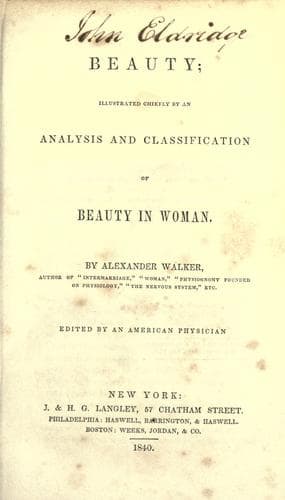
Beauty: Illustrated Chiefly by an Analysis and Classification of Beauty in WomanWalker, Alexander
Philosophy
Beauty: Illustrated Chiefly by an Analysis and Classification of Beauty in Woman
Walker, Alexander
Beauty, Personal; Women
It maybe set down, we suppose, as a matter sufficiently settled to become
a principle, that men are moved by nothing more generally and certainly
than by the power of Beauty--particularly Beauty in Woman. That it has an
influence upon _all_ of one sex, like that which Master Shakspeare has
given picture of in the lines we have set upon our front, we would not
pretend to say: but that the wild bard was no freshman in his knowledge of
humanity so far as heart and mind matters were concerned, we feel safe to
assert--and feel confident that the passionate language of Romeo
trespasses no bounds, and is but a faithful declaration of a power that
rules with a milder or a mightier sway in the bosoms of all who answer to
the distinctive name of Man.
This may seem a wide assertion. But it is no less true. The reason of the
slow belief in this universality is, that men are not always subject to
the influence, while the principle of it is always a tenant within them.
There is a time--and with the time comes the development. The mind, as it
unfolds, becomes acquainted with nothing so calculated to excite its
wonder, as its own properties and capabilities--its new perceptions--its
new affections. Till progress brings with it this knowledge of ourselves,
we remain ignorant of half that is within us to affect us like a spell,
and within whose reach we have been unconsciously passing onward and
upward, by a Providential ordering, from our childhood at least, if not
from our cradles.
Keeping this in view, let us consider for a moment something of the
elements of Beauty, and their influence, as a principle, upon the
principles of our nature.--And first it must be admitted that they are
good--of a good origin--and tend to a good result. They are good elements,
we believe, for we find them almost ever associated with what is pleasing,
improving, and satisfactory to us. Indeed, in this connexion, we find them
a source of consolation and delight, where all else has failed to minister
or even suggest them. They are of a good origin--for, if they were not, no
such effect would be wrought upon a system so sadly prone to evil and
villanous principles, and so little open to pure, and elevating, and
comforting ones, that they may be said to come about it, most
emphatically, like "angel-visits." They are elements, again, that tend to
a good result, in their operation, for their consequences are almost ever,
to make men better satisfied with their condition--where they come in, as
an influence upon it, at all--better satisfied with almost everything
about them, so long as they are conscious they are creatures of
proportions and proprieties, and affected intrinsically by them.
Public-domain text, read in full here on John Shaqi.
Reviews
Reviews
No reviews yet
Be the first to share your thoughts on this work.
Join the Discussion
Join the discussion
Sign in to leave a comment or review.
Sign InorCreate an account