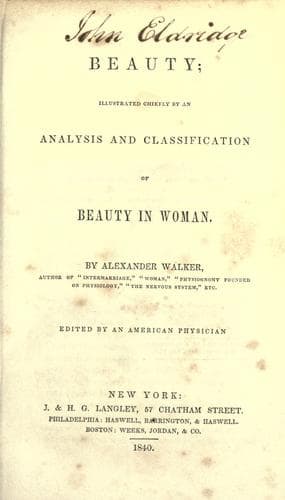
Beauty: Illustrated Chiefly by an Analysis and Classification of Beauty in WomanWalker, Alexander
Philosophy
Beauty: Illustrated Chiefly by an Analysis and Classification of Beauty in Woman
Walker, Alexander
Beauty, Personal; Women
This writer endeavors to establish his views on this subject, by
observing, that "grandeur or sublimity of sound, can no otherwise arise
from its loudness, than as that loudness excites an idea of power in the
sonorous object, or in some other associated with it in the mind: for a
child's drum, close to the ear, fills it with more real noise, than the
discharge of a cannon a mile off; and the rattling of a carriage in the
street, when faintly and indistinctly heard, has often been mistaken for
thunder at a distance. Yet no one ever imagined the beating of a child's
drum, or the rattling of a carriage over the stones, to be grand or
sublime; which, nevertheless, they must be, if grandeur or sublimity
belong at all to the sensation of loudness. But artillery and lightning
are powerful engines of destruction; and with their power we sympathize,
whenever the sound of them excites any sentiments of sublimity."
Now, all this is directly opposed to the doctrine it is meant to support.
It distinctly implies that loudness is so natural and so frequent a result
of the violent contact of bodies, that we sometimes mistakenly ascribe
power to objects, of which we have not correctly distinguished the sounds,
owing to imitation, distance, &c. The occasional mistake implies the
general truth.
Alison, himself, notwithstanding his doctrine of association, is
accordingly led to observe, that "there are some philosophers who consider
these as the natural signs of passion or affection, and who believe that
it is not from experience, but by means of an original faculty, that we
interpret them: and this opinion is supported by great authorities."
He adds the following observations, which, notwithstanding the error they
involve, are too much to the purpose to be omitted here, and which in
reality illustrate a natural and true theory, better than they do his
own:--
"It is natural, however, to suppose, that in this, as in every case, our
experience should gradually lead to the formation of some general rules,
with regard to this expression.
"The great divisions of sound are into loud and low, grave and acute, long
and short, increasing and diminishing. The two first divisions are
expressive in themselves: the two last, only in conjunction with others.
"Loud sound is connected with ideas of power and danger. Many objects in
nature which have such qualities, are distinguished by such sounds; and
this association is farther confirmed from the human voice, in which all
violent and impetuous passions are expressed in loud tones.
"Low sound has a contrary expression, and is connected with ideas of
weakness, gentleness, and delicacy. This association takes its rise, not
only from the observation of inanimate nature, or of animals, where, in a
great number of cases, such sounds distinguish objects with such
qualities, but particularly from the human voice, where all gentle, or
delicate, or sorrowful affections are expressed by such tones.
Public-domain text, read in full here on John Shaqi.
Reviews
Reviews
No reviews yet
Be the first to share your thoughts on this work.
Elsewhere in the archive
Join the Discussion
Join the discussion
Sign in to leave a comment or review.
Sign InorCreate an account