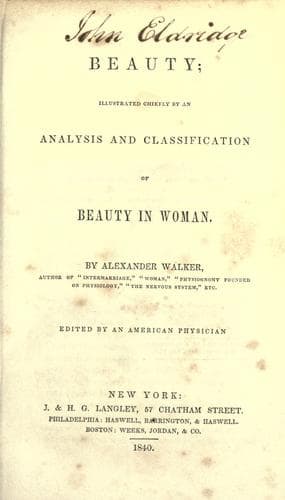
Beauty: Illustrated Chiefly by an Analysis and Classification of Beauty in WomanWalker, Alexander
Philosophy
Beauty: Illustrated Chiefly by an Analysis and Classification of Beauty in Woman
Walker, Alexander
Beauty, Personal; Women
"Grave sound is connected with ideas of moderation, dignity, solemnity,
&c., principally, I believe, from all moderate, or restrained, or
chastened affections being distinguished by such tones in the human voice.
"Acute sound is expressive of pain, or fear, or surprise, &c., and
generally operates by producing some degree of astonishment. This
association, also, seems principally to arise from our experience of such
connexions in the human voice.
"Long or lengthened sound seems to me to have no expression in itself, but
only to signify the continuance of that quality which is signified by
other qualities of sound. A loud or a low, a grave or an acute sound
prolonged expresses to us no more than the continuance of the quality
which is generally signified by such sounds.
"Short or abrupt sound has a contrary expression, and signifies the sudden
cessation of the quality thus expressed.
"Increasing sound signifies, in the same manner, the increase of the
quality expressed.
"Decreasing sound signifies the gradual diminution of such qualities.
"Motion furnishes another sort of beauty.
"Figure, color, and motion, readily blend in one object, and one general
perception of beauty. In many beautiful objects they all unite, and
render the beauty greater."
These characteristics are too universal not to support the doctrine of
natural appropriation and power, of which association is merely a
consequence.
It may be said, that all this chiefly regards mere geometrical forms, not
objects in nature. But, on referring to inanimate objects, it will be
found that they everywhere present these forms.
The round, the simplest form appears to characterize all elementary bodies
and all that are free from compression, to be in fact the most elementary
and the most readily assumed in nature. This form, accordingly, is
presented by the drops of water and of every liquid, by every atom
probably of oxygen, hydrogen, and azote, by the smallest as well as the
largest bodies, even the innumerable celestial orbs.
All the other, the angular forms are presented by inanimate bodies under
compression, or by mineral crystals.
Thus, then, do these simple geometrical forms characterize the simplest
bodies in nature; and it appears that this first kind of beauty is
peculiarly their own. It will, in the sequel, be as clearly seen, that
each of the other classes of natural beings presents beauty of a different
kind, which similarly characterizes it. Hence, no rational theory of
beauty could be formed by writers, who indiscriminatingly jumbled together
the characteristics of all the kinds of beauty, and expected to find them
everywhere.
Public-domain text, read in full here on John Shaqi.
Reviews
Reviews
No reviews yet
Be the first to share your thoughts on this work.
Elsewhere in the archive
Join the Discussion
Join the discussion
Sign in to leave a comment or review.
Sign InorCreate an account