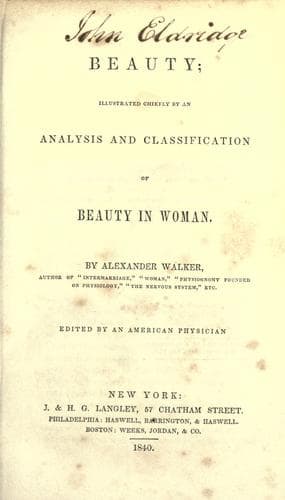
Beauty: Illustrated Chiefly by an Analysis and Classification of Beauty in WomanWalker, Alexander
Philosophy
Beauty: Illustrated Chiefly by an Analysis and Classification of Beauty in Woman
Walker, Alexander
Beauty, Personal; Women
"How much more beautiful," he says, "is the rose-tree when its buds begin
to blow, than afterward, when its flowers are full and in their greatest
perfection! yet, in this first situation, its form has much less winding
surface, and is much more composed of straight lines and of angles, than
afterward when the weight of the flower weighs down the feeble branches,
and describes the easiest and most varied curves."--But he answers himself
by adding: "The circumstance of its youth, a circumstance in all cases so
affecting, the delicacy of its blossom, so well expressed by the care
which Nature has taken in surrounding the opening bud with leaves, prevail
so much upon our imagination, that we behold the form itself with more
delight in this situation than afterward, when it assumes the more general
form of delicacy."
"There are few things in the vegetable world," he says, "more beautiful
than the knotted and angular stem of the balsam, merely from its singular
transparency, which it is impossible to look at without a strong
impression of the fineness and delicacy of the vegetable."--But it is its
transparency, not its angularity, that is beautiful.
The beauty of color is not less conspicuous than that of form in this
class of beings.
SECTION III.
ELEMENTS OF BEAUTY IN THINKING BEINGS.
I have next to show that, in thinking beings, while the characters of
inanimate, and those of living beauty, are still more or less continued,
new characteristics are also added to them.
I. In animals, accordingly, the bones bear a close analogy to the wood of
plants. They generally assume the same rounded form; but, as thinking
beings are necessarily moving ones, their bones are hollow to combine
lightness with strength, and they are separated by joints to permit
flexion and extension.
II. As animals, like plants, grow and reproduce, a portion of their
general organization, their vascular system, which serves the purpose of
growth and reproduction, consists, like plants, of trunks, branches, &c.;
and the surface of their bodies, the skin, is formed by a tissue of these
vessels. Accordingly, both the vessels themselves, and the tissue which
they form, present the delicacy, the bending, the variety, and the
contrast, which are the characters of the preceding species of beauty.
Public-domain text, read in full here on John Shaqi.
Reviews
Reviews
No reviews yet
Be the first to share your thoughts on this work.
Elsewhere in the archive
Join the Discussion
Join the discussion
Sign in to leave a comment or review.
Sign InorCreate an account