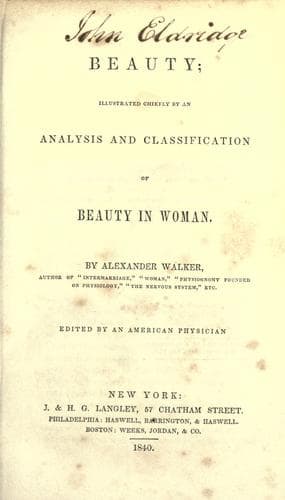
Beauty: Illustrated Chiefly by an Analysis and Classification of Beauty in WomanWalker, Alexander
Philosophy
Beauty: Illustrated Chiefly by an Analysis and Classification of Beauty in Woman
Walker, Alexander
Beauty, Personal; Women
It is scarcely necessary to observe that variety, as a character of
beauty, owes its effect to the need of changing impressions, in order to
enliven our sensibility, which does not fail to become inactive under the
long-continued impression of the same stimulant.
It is connected with this variety that unequal numbers are preferred, as
we see in the number of flowers and of their petals, in that of leaves
grouped together, and in the indentations of these leaves.
From all this springs the fourth and last characteristic of this second
species of beauty, namely, contrast. This strikes us when we at once look
at the rigid stem and bending boughs, and all the variety which the latter
display.
It will be observed, that, of all the characteristics of beauty, none tend
to render our perceptions so vivid as variety and contrast.
I conclude this section with a few remarks on the errors which Alison has
committed on this subject.
"In the rose," says that writer, "and the white lily, and in the tribe of
flowering shrubs, the same bending form assumed by the stem is felt as a
defect; and instead of impressing us with the idea of delicacy, leads us
to believe the operation of some force to twist it into this
direction."--This, however, is no defect arising from the bending form not
being abstractly more beautiful, but from its being contrary to the nature
of the stem of flowering shrubs to bend, from its being, as he himself
observes, the result of some force to twist it.
He asserts, however, that in plants, angular forms are beautiful, when
they are expressive of fineness, of tenderness, of delicacy, or such
affecting qualities; and he thinks that this may perhaps appear from the
consideration of the following instances:--
"The myrtle, for instance, is generally reckoned a beautiful form, yet the
growth of its stem is perpendicular, the junction of its branches form
regular and similar angles, and their direction is in straight or angular
lines. The known delicacy, however, and tenderness of the vegetable, at
least in this climate, prevail over the general expression of the form,
and give it the same beauty which we generally find in forms of a contrary
kind."--The mistake here committed is in supposing the beauty of the
myrtle to depend on its angularity, instead of its being evergreen,
fragrant, and suggesting pleasures of association.
Public-domain text, read in full here on John Shaqi.
Reviews
Reviews
No reviews yet
Be the first to share your thoughts on this work.
Elsewhere in the archive
Join the Discussion
Join the discussion
Sign in to leave a comment or review.
Sign InorCreate an account