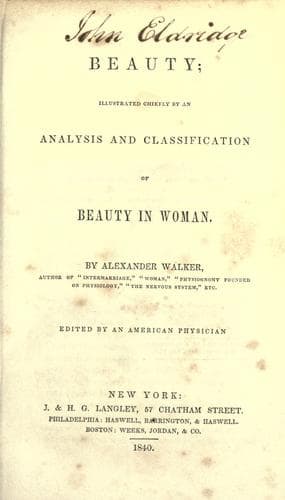
Beauty: Illustrated Chiefly by an Analysis and Classification of Beauty in WomanWalker, Alexander
Philosophy
Beauty: Illustrated Chiefly by an Analysis and Classification of Beauty in Woman
Walker, Alexander
Beauty, Personal; Women
"It must be remembered," says Knight, "that irregularity is the general
characteristic of trees, and regularity that of animals."--It would have
been more correct to say that symmetry is this peculiar characteristic.
There is little resemblance between the parts of one side; and it is
symmetry which results from the uniform disposition of double parts, and
from the regular division of single ones.
Hence an agreeable impression is produced by the corresponding disposition
and the exact resemblance of the eyes, of the eyebrows, of the ears, of
the hemispheres of the bosom, and of the different parts of which the
limbs are composed; and the forehead, the nose, the mouth, the abdomen,
the back, are agreeably distinguished by means of the median line which
divides them.
It appears that the eye is pleased by the exactness of corresponding
parts; and that symmetry is the first character of beauty in thinking
beings.
Occasional irregularity makes us better appreciate the importance of
symmetry. The oblique direction of the eyes, squinting, twisting of the
nose or lips, unequal magnitude of the hemispheres of the bosom, or
unequal length of the limbs, disfigure the most beautiful person.
But how does symmetry contribute to fitness, or why is it necessary?
"All our limbs and organs," says Payne Knight, "serve us in pairs, and by
mutual co-operation with each other: whence the habitual association of
ideas has taught us to consider this uniformity as indispensable to the
beauty and perfection of the animal form. There is no reason to be deduced
from any abstract consideration of the nature of things, why an animal
should be more ugly and disgusting for having only one eye, or one ear,
than for having only one nose or one mouth; yet if we were to meet with a
beast with one eye, or two noses, or two mouths, in any part of the world,
we should, without inquiry, decide it to be a monster, and turn from it
with abhorrence: neither is there any reason, in the nature of things, why
a strict parity, or relative equality, in the correspondent limbs and
features of a man or a horse, should be absolutely essential to beauty,
and absolutely destructive of it in the roots and branches of a tree. But,
nevertheless, the Creator having formed the one regular, and the other
irregular, we habitually associate ideas of regularity to the perfection
of one, and ideas of irregularity to the perfection of the other; and this
habit has been so unvaried, as to have become natural."
Public-domain text, read in full here on John Shaqi.
Reviews
Reviews
No reviews yet
Be the first to share your thoughts on this work.
Elsewhere in the archive
Join the Discussion
Join the discussion
Sign in to leave a comment or review.
Sign InorCreate an account