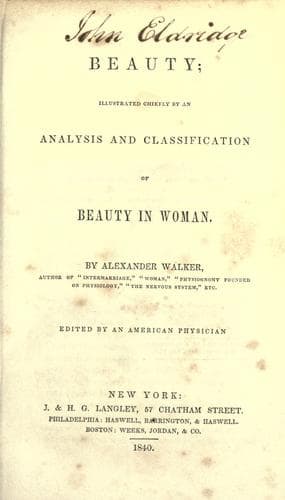
Beauty: Illustrated Chiefly by an Analysis and Classification of Beauty in WomanWalker, Alexander
Philosophy
Beauty: Illustrated Chiefly by an Analysis and Classification of Beauty in Woman
Walker, Alexander
Beauty, Personal; Women
This is the common cant of every weak man at loss for a reason. Now, it is
not by any "habitual association" with "our limbs and organs serving us in
pairs," that we are "taught to consider this uniformity indispensable to
beauty," but because, independent of all association, we could not
conveniently walk upon one leg, or, indeed, on any unequal number of legs:
and there being two sides in the moving organs, there are necessarily two
in the sensitive organs, which are mere portions of the same general
system. Thus it is locomotion to be performed that renders "a strict
parity, or relative equality, in the correspondent limbs and features of a
man or a horse" absolutely essential to beauty; and it is the absence of
locomotion which renders it utterly worthless, and therefore very rare, in
"the roots and branches of a tree."
In animals, proportion is not less essential than symmetry. It is indeed
the second character of this kind of beauty. As this part of the subject
has been perfectly well treated by Mr. Alison, I need only quote what he
has said:--
"It is this expression of fitness which is, I apprehend, the source of the
beauty of what is strictly and properly called proportion in the parts of
the human form.
"We expect a different form, and a different conformation of limbs, in a
running footman and a waterman, in a wrestler and a racing groom, in a
shepherd and a sailor, &c.
"They who are conversant in the productions of the fine arts, must have
equally observed, that the forms and proportions of features, which the
sculptor and the painter have given to their works, are very different,
according to the nature of the character they represent, and the emotion
they wish to excite. The form or proportions of the features of Jove are
different from those of Hercules; those of Apollo, from those of Ganymede;
those of the Fawn, from those of the Gladiator. In female beauty, the form
and proportions in the features of Juno are very different from those of
Venus; those of Minerva, from those of Diana; those of Niobe, from those
of the Graces. All, however, are beautiful; because all are adapted with
exquisite taste to the characters they wish the countenance to express."
In "the Hercules and the Antinous, the Jupiter and the Apollo, we find
that not only the proportions of the form, but those of every limb, are
different; and that the pleasure we feel in these proportions arises from
their exquisite fitness for the physical ends which the artists were
consulting.
"The illustration, however, may be made still more precise; for, even in
the same countenance, and in the same hour, the same form of feature may
be beautiful or otherwise."
SECTION IV.
ELEMENTS OF BEAUTY AS EMPLOYED IN OBJECTS OF ART.
Public-domain text, read in full here on John Shaqi.
Reviews
Reviews
No reviews yet
Be the first to share your thoughts on this work.
Elsewhere in the archive
Join the Discussion
Join the discussion
Sign in to leave a comment or review.
Sign InorCreate an account