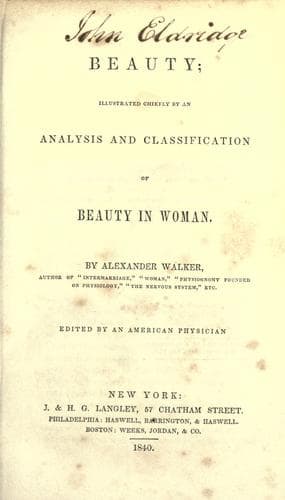
Beauty: Illustrated Chiefly by an Analysis and Classification of Beauty in WomanWalker, Alexander
Philosophy
Beauty: Illustrated Chiefly by an Analysis and Classification of Beauty in Woman
Walker, Alexander
Beauty, Personal; Women
"In those trains which are suggested by objects of sublimity or beauty,
however slight the connexion between individual thoughts may be, it will
be found, that there is always some general principle of connexion which
pervades the whole, and gives them some certain definite character. They
are either gay, or pathetic, or melancholy, or solemn, or awful, or
elevating, &c., according to the nature of the emotion which is first
excited. Thus the prospect of a serene evening in summer, produces first
an emotion of peacefulness and tranquillity, and then suggests a variety
of images corresponding to this primary impression. The sight of a
torrent, or of a storm, in the same manner, impresses us first with
sentiments of awe or solemnity, or terror, and then awakens in our minds a
series of conceptions allied to this peculiar emotion."
The intellectual, or fine arts are those whose objects are thus addressed
to the imagination; and the pleasures they afford are described, by way of
distinction, as the pleasures of the imagination.
SUMMARY OF THIS CHAPTER.
Thus, by analysis, generalization, and systematization, of the materials
which the best writers present, I have, in this chapter, endeavored to
take new and larger views; and, by an examination of the elements of
beauty, I have endeavored to fix its doctrines upon an immoveable basis.
I have shown that there exist elements of beauty equally invariable in
themselves, and in the kind of effect they produce upon the mind; that
these elements are modified, varied, and complicated, as we advance from
the most simple to the most complex class of natural beings, or of the
arts which relate to these respectively; that the elements of beauty in
inanimate beings, consist in the simplicity, regularity, uniformity,
proportion, order, &c., of those geometrical forms which are so intimately
connected with mere existence; that the elements of beauty in living
beings, consist in adding to the preceding the delicacy, bending, variety,
contrast, &c., which are connected with growth, and reproduction; that the
elements of beauty in thinking beings, consist in adding to the preceding
the symmetry, proportion,[15] &c., which are connected with fitness for
sense, thought, and motion; that the elements of beauty in the objects of
useful art, consist in the same simplicity, regularity, uniformity,
proportion, order, of geometrical forms which belong to inanimate beings;
that the elements of beauty in the objects of ornamental art consist in
the same delicacy, bending, variety, contrast, which belong to living
beings; and that the elements of beauty in the objects of intellectual art
consist in thinking forms, in gesture, sculpture, and painting, or in
functions of mind actually exercised, in oratory, poetry, and music.
Public-domain text, read in full here on John Shaqi.
Reviews
Reviews
No reviews yet
Be the first to share your thoughts on this work.
Elsewhere in the archive
Join the Discussion
Join the discussion
Sign in to leave a comment or review.
Sign InorCreate an account