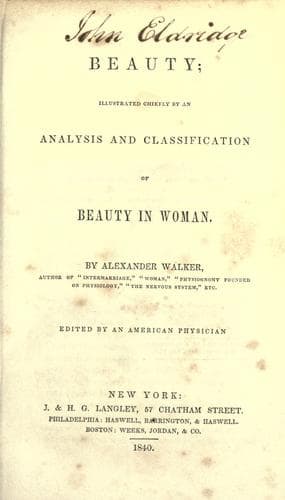
Beauty: Illustrated Chiefly by an Analysis and Classification of Beauty in WomanWalker, Alexander
Philosophy
Beauty: Illustrated Chiefly by an Analysis and Classification of Beauty in Woman
Walker, Alexander
Beauty, Personal; Women
Thus, on a remote country-road, we often observe the deep ruts on its
surface which in winter would render it impassable--the huge and loose
moss-grown stone, ready to encumber it by falling from the bank--the
stunted pollard by its side, whose roots are exposed by the earth falling
away from it, and which must itself be swept away by the first wind that
may blow against it in an unfavorable direction--the almost ruined
cottage, above and beyond these, whose gable is propped up by an old and
broken wheel, and whose thatched roof, stained with every hue of moss or
lichen, has, at one part, long fallen in--the shaggy and ragged horse that
browses among the rank weeds around it--and the old man, bent with age,
who leans over the broken gate in front of it.
Here, in every circumstance, is verified the irregularity and roughness
which Price ascribes to the picturesque. But he has failed to observe,
that _the irregularity and roughness are but the signs of that which
interests the mind far more deeply_, namely, the universal DECAY which
causes them. This is the essence of the picturesque--the charm in it which
begets our sympathy.
Confining his remark merely to ruins, the author of "Observations on
Gardening," says: "At the sight of a ruin, reflections on the change, the
decay, and the desolation, before us naturally occur; and they introduce a
long succession of others, all tinctured with that melancholy which these
have inspired; or if the monument revive the memory of former times, we do
not stop at the simple fact which it records, but recollect many more
coeval circumstances which we see, nor perhaps as they were, but as they
are come down to us, venerable with age, and magnified by fame."--What is
here said of ruins, and is indeed as to them sufficiently striking, is
true of the picturesque universally, and it is only surprising that, amid
such disputes, this simple and obvious truth should not have been
observed.
In landscape, therefore, the picturesque stands in the same relation to
the beautiful and sublime, that the pathetic does to them in poetry.
Hence, speaking also of ruins only, Alison says: "The images suggested by
the prospect of ruins, are images belonging to pity, to melancholy, and to
admiration."
A thousand illustrations might be given in support of this truth and the
principle which it affords; but I think it better to leave these to the
suggestion or the choice of every reader.
SECTION II.
CAUSE OF LAUGHTER.
This has been partly explained by Beattie, partly by Hobbes; and it is
chiefly to vindicate the latter, who knew much more of the human mind than
the people who have attacked him, that I write the pages immediately
following.
Public-domain text, read in full here on John Shaqi.
Reviews
Reviews
No reviews yet
Be the first to share your thoughts on this work.
Elsewhere in the archive
Join the Discussion
Join the discussion
Sign in to leave a comment or review.
Sign InorCreate an account