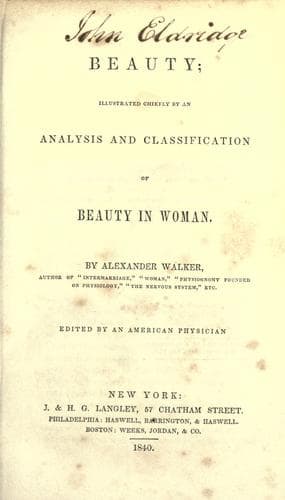
Beauty: Illustrated Chiefly by an Analysis and Classification of Beauty in WomanWalker, Alexander
Philosophy
Beauty: Illustrated Chiefly by an Analysis and Classification of Beauty in Woman
Walker, Alexander
Beauty, Personal; Women
Speaking of the quality in things, which makes them provoke the pleasing
emotion or sentiment of which laughter is the external sign, Beattie says:
"It is an uncommon mixture of relation and contrariety, exhibited, or
supposed to be united, in the same assemblage." And elsewhere he says:
"Laughter arises from the view of two or more inconsistent, unsuitable, or
incongruous parts or circumstances, considered as united in one complex
object or assemblage, or as acquiring a sort of mutual relation from the
peculiar manner in which the mind takes notice of them."
"The latter may arise from contiguity, from the relation of cause and
effect, from unexpected likeness, from dignity and meanness, from
absurdity, &c.
"Thus, at first view, the dawn of the morning and a boiled lobster seem
utterly incongruous, but when a change of color from black to red is
suggested, we recognise a likeness, and consequently a relation, or ground
of comparison.
"And here let it be observed, that the greater the number of incongruities
that are blended in the same assemblage, the more ludicrous it will
probably be. If, as in the last example, there be an opposition of dignity
and meanness, as well as of likeness and dissimilitude, the effect of the
contrast will be more powerful, than if only one of these oppositions had
appeared in the ludicrous idea."
The first part of the subject seems, indeed, so clear as to admit of no
objection.
Hobbes, viewing more particularly the act of the mind, defines laughter to
be a "sudden glory, arising from a sudden conception of some eminency in
ourselves, by comparison with the infirmity of others, or with our own
formerly." And elsewhere he says: "Men laugh at jests, the wit whereof
always consisteth in the elegant discovering and conveying to our minds,
some absurdity of another."[18]
Dr. Campbell objects that "contempt may be raised in a very high degree,
both suddenly and unexpectedly, without producing the least tendency to
laugh." But if there exist that incongruity in the same assemblage
described as the fundamental cause of this sudden conception of our own
superiority, laughter, as Beattie has shown, "will always, or for the most
part, excite the risible emotion, unless when the perception of it is
attended with some other emotion of greater authority," dependant on
custom, politeness, &c.
Dr. Campbell also observes, that "laughter may be, and is daily, produced
by the perception of incongruous associations, when there is no contempt.
"We often smile at a witty performance or passage, such as Butler's
allusion to a boiled lobster, in his picture of the morning, when we are
so far from conceiving any inferiority or turpitude in the author, that
we greatly admire his genius, and wish ourselves possessed of that very
turn of fancy which produced the drollery in question.
"Many have laughed at the queerness of the comparison in these lines,
Public-domain text, read in full here on John Shaqi.
Reviews
Reviews
No reviews yet
Be the first to share your thoughts on this work.
Elsewhere in the archive
Join the Discussion
Join the discussion
Sign in to leave a comment or review.
Sign InorCreate an account