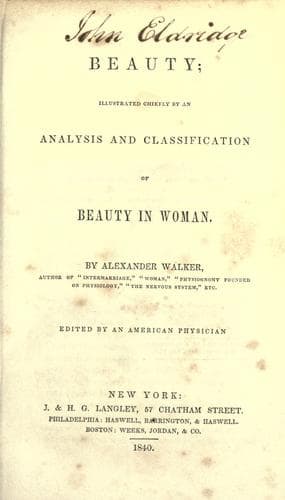
Beauty: Illustrated Chiefly by an Analysis and Classification of Beauty in WomanWalker, Alexander
Philosophy
Beauty: Illustrated Chiefly by an Analysis and Classification of Beauty in Woman
Walker, Alexander
Beauty, Personal; Women
But he overlooks the precise terms employed by Hobbes, who says: "The
passion of laughter is nothing else but sudden glory, arising from a
sudden conception of some eminency in ourselves, by comparison with the
infirmity of others, or with _our own formerly_. For men laugh at _the
follies of themselves past_, when they come suddenly to remembrance,
_except they bring with them any present dishonor_."
It is not therefore true, as Dr. Campbell says, that "with regard to
others, he appears solely under the notion of inferiority, as the person
triumphed over." He, on the contrary, appears as achieving a very glorious
triumph, that, namely, over his own errors.
This shows also the error of Addison's remarks, that "according to this
account, when we hear a man laugh excessively, instead of saying that he
is very merry, we ought to tell him that he is very proud."--A man may
contemn the errors both of himself and others, without pride: and, indeed,
in contemning the former, he proves himself to be far above that
sentiment, and verifies Dr. Campbell's remark that no two characters more
rarely meet in the same person, than that of a very risible man, and a
very self-conceited supercilious man.
It is curious to see a great man, like Hobbes, thus attacked by less ones,
who do not even understand him.
SECTION III.
CAUSE OF THE PLEASURE RECEIVED FROM REPRESENTATIONS EXCITING PITY.
Many hypotheses have been proposed to explain this cause.
According to the Abbé Du Bos,[19] in order to get rid of listlessness, the
mind seeks for emotions; and the stronger these are the better. Hence, the
passions which in themselves are the most distressing, are, for this
purpose, preferable to the pleasant, because they most effectually relieve
the mind from the less endurable languor which preys upon it during
inaction.
The sophistry of this explanation is evident. Pleasant passions, as Dr.
Campbell has shown, ought in every respect to have the advantage, because,
while they preserve the mind from this state of inaction, they convey a
feeling which is agreeable. Nor is it true that the stronger the emotion
is, so much the fitter for this purpose; for if we exceed a certain
measure, instead of a sympathetic and delightful sorrow, we excite only
horror and aversion. The most, therefore, that can be concluded from the
Abbé's premises, is, that it is useful to excite passion of some kind or
other, but not that the distressing ones are the fittest.
According to Fontenelle,[20] theatrical representation has almost the
effect of reality: but yet not altogether. We have still a certain idea of
falsehood in the whole of what we see. We weep for the misfortunes of a
hero to whom we are attached. In the same instant, we comfort ourselves by
reflecting, that it is nothing but a fiction.
The short answer to this is, that we are conscious of no such alternation
as that here described.
Public-domain text, read in full here on John Shaqi.
Reviews
Reviews
No reviews yet
Be the first to share your thoughts on this work.
Elsewhere in the archive
Join the Discussion
Join the discussion
Sign in to leave a comment or review.
Sign InorCreate an account