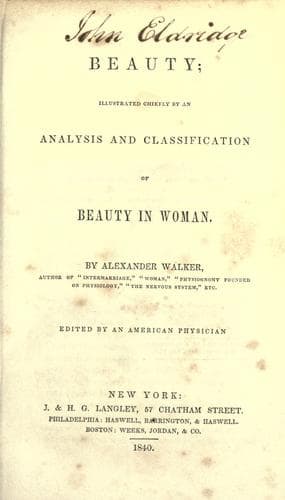
Beauty: Illustrated Chiefly by an Analysis and Classification of Beauty in WomanWalker, Alexander
Philosophy
Beauty: Illustrated Chiefly by an Analysis and Classification of Beauty in Woman
Walker, Alexander
Beauty, Personal; Women
According to David Hume, whose hypothesis is a kind of supplement to the
former two, that which "when the sorrow is not softened by fiction, raises
a pleasure from the bosom of uneasiness, a pleasure which still retains
all the features and outward symptoms of distress and sorrow, is that very
eloquence with which the melancholy scene is represented."
In reply, Dr. Campbell has shown that the aggravating of all the
circumstances of misery in the representation, cannot make it be
contemplated with pleasure, but must be the most effectual method for
making it give greater pain; that the detection of the speaker's talents
and address, which Hume's hypothesis implies, is in direct opposition to
the fundamental maxim, that "it is essential to the art to conceal the
art;" and that the supposition that there are two distinct effects
produced by the eloquence on the hearers, one the sentiment of beauty, or
of the harmony of oratorical numbers, the other the passion which the
speaker purposes to raise in their minds, and that when the first
predominates, the mixture of the two effects becomes exceedingly pleasant,
and the reverse when the second is superior, is altogether imaginary.
According to Hawkesworth,[21] the compassion in question may be "resolved
into that power of imagination, by which we apply the misfortunes of
others to ourselves;" and we are said "to pity no longer than we fancy
ourselves to suffer, and to be pleased only by reflecting that our
sufferings are not real; thus indulging a dream of distress, from which we
can awake whenever we please, to exult in our security, and enjoy the
comparison of the fiction with the truth."
This hypothesis is evidently too gross to need reply.
Dr. Campbell has answered the preceding hypotheses at great length, and
quite satisfactorily. I regret to say that his own is as worthless, as
well as remarkably confused and unintelligible.
To Burke, who wrote at a later period, it falls to my lot to reply at
greater length.
Public-domain text, read in full here on John Shaqi.
Reviews
Reviews
No reviews yet
Be the first to share your thoughts on this work.
Elsewhere in the archive
Join the Discussion
Join the discussion
Sign in to leave a comment or review.
Sign InorCreate an account