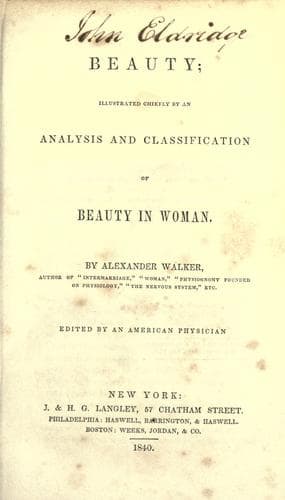
Beauty: Illustrated Chiefly by an Analysis and Classification of Beauty in WomanWalker, Alexander
Philosophy
Beauty: Illustrated Chiefly by an Analysis and Classification of Beauty in Woman
Walker, Alexander
Beauty, Personal; Women
Even Burke, notwithstanding his want of discrimination, and his monstrous
hypothesis, says: "Imitated distress is never so perfect, but we can
perceive it is imitation, and on that principle are somewhat pleased with
it." And his case of desertion of the theatre, if it occur under any
circumstances, illustrates this.
Burke adds, indeed: "But then I imagine we shall be much _mistaken_ if we
attribute any considerable part of our satisfaction in tragedy to the
consideration that tragedy is _a deceit_, and its representations _no
realities_. [We seek no satisfaction of the kind: we know it to be a
deceit throughout!] The nearer it approaches the reality, and the farther
it removes us from all idea of fiction, the more perfect is its power."
The nearest possible _approach_ to reality, is only necessary to the
success of fiction, to the pleasure of imagination. He himself has said:
"Imitated distress is never so perfect, but we can perceive it is
imitation!" Again, therefore, here is only Burke's characteristic
confusion of ideas.
My own doctrine on this subject is already obvious from the remarks made
on others. _We never cease to know that tragic representation is a mere
deception; our reason is never imposed upon; our imagination is alone
engaged; we are perfectly conscious that it is so; and we have all the
sensibility, fine feeling, and generosity of pity, as well as the
satisfaction of being thereby raised wonderfully in our own esteem, at the
small cost of three shillings!_
It is not a little curious, that this should not have been evident to
those who have written so much about it. Dr. Campbell, alone, has
approached it. "So great," he says, "is the anomaly which sometimes
displays itself in human characters, that it is not impossible to find
persons who are quickly made to cry at seeing a tragedy, or reading a
romance, which they know to be fictions, and yet are both inattentive and
unfeeling in respect of the actual objects of compassion who live in their
neighborhood, and are daily under their eye.... Men may be of a selfish,
contracted, and even avaricious disposition, who are not what we should
denominate hard-hearted, or unsusceptible of sympathetic feeling. Such
will gladly enjoy the luxury of pity (as Hawkesworth terms it) when it
nowise interferes with their more powerful passions; that is, when it
comes unaccompanied with a demand upon their pockets."--This should have
led him to the simple truth, and should have prevented his framing the
most confused, unintelligible, and worthless hypothesis upon this
subject.
CHAPTER VII.
ANATOMICAL AND PHYSIOLOGICAL PRINCIPLES.
To any inquiry respecting the beauty of woman, the replies are, in
general, various, inconsistent, or contradictory. The assertion might,
therefore, appear to be true, that, even under the same climate, beauty is
not always the same.
Public-domain text, read in full here on John Shaqi.
Reviews
Reviews
No reviews yet
Be the first to share your thoughts on this work.
Elsewhere in the archive
Join the Discussion
Join the discussion
Sign in to leave a comment or review.
Sign InorCreate an account