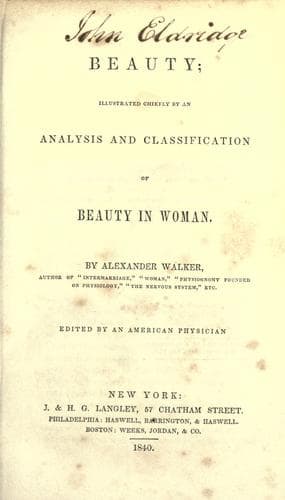
Beauty: Illustrated Chiefly by an Analysis and Classification of Beauty in WomanWalker, Alexander
Philosophy
Beauty: Illustrated Chiefly by an Analysis and Classification of Beauty in Woman
Walker, Alexander
Beauty, Personal; Women
"This noble capital," he says, "the pride of England and of Europe, I
believe _no man is so strangely wicked as to desire to see destroyed_ by a
conflagration or an earthquake, though he should be removed himself to the
greatest distance from the danger. But _suppose such a fatal accident to
have happened_, what numbers from all parts would crowd to behold the
ruins, and among them many who would have been content never to have seen
London in its glory!"
Here the words which I have put in italics clearly show that I was right
in the additions I suggested in his previous statement, and that he there
confounded delight in seeing the infliction of unmerited suffering, with
delight in seeing it after infliction, or of seeing it historically
narrated; for, in this his illustration, it is the latter, and not the
former, that he supposes--nay he now says "no man is so strangely wicked
as to desire to see destroyed!" &c. Indeed, it is quite plain that,
supposing an attempt made to destroy London, so far would every one be
from being delighted to see it done, that he would eagerly prevent it.
There is here, therefore, on the part of this writer, only his common and
characteristic confusion of ideas.
"Choose a day," he says, "on which to represent the most sublime and
affecting tragedy we have; appoint the most favorite actors; spare no cost
upon the scenes and decorations; unite the greatest efforts of poetry,
painting, and music; and when you have collected your audience, just at
the moment when their minds are erect with expectation, let it be reported
that a state-criminal, of high rank, is on the point of being executed in
the adjoining square; in a moment the emptiness of the theatre would
demonstrate the comparative weakness of the imitative arts, and proclaim
the triumph of the real sympathy."
This presents only another instance of want of discrimination. If the
"state-criminal, of high rank," were not a real criminal--if he were an
unmerited sufferer, the place of execution, supposing his rescue
impossible, would assuredly be fled from by every person of feeling and
honor; as we read of in the public papers, lately, when a murder of that
kind was perpetrating by some one of the base little jailor-princes of
Germany. And we know that, in the case of legal perpetrations of that kind
in England, even upon real criminals, none but the most degraded wretches
go to witness such scenes.
In tragic representation, then, we know that the suffering is not real,
else should we fly. There have, indeed, in such cases, been instances of a
sort of momentary deception, but it is only children, and very simple
people, utter strangers to theatrical amusements, who are apt to be so
deceived; and as their case always excites the surprise and laughter of
every one, it clearly proves that others are under no sort of deception.
Public-domain text, read in full here on John Shaqi.
Reviews
Reviews
No reviews yet
Be the first to share your thoughts on this work.
Elsewhere in the archive
Join the Discussion
Join the discussion
Sign in to leave a comment or review.
Sign InorCreate an account