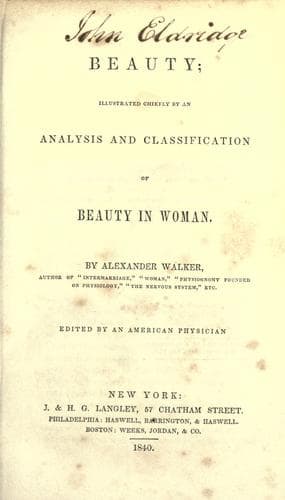
Beauty: Illustrated Chiefly by an Analysis and Classification of Beauty in WomanWalker, Alexander
Philosophy
Beauty: Illustrated Chiefly by an Analysis and Classification of Beauty in Woman
Walker, Alexander
Beauty, Personal; Women
In many women, however, nutrition languishes even until the sexual organs
enter into action, and determine a revolution under the influence of which
growth is accomplished.
Still it is certain that, for several years, the locomotive system
predominates in young women, even in figures promising the ultimate
development of the vital system in the highest degree.
The second age of woman extends from puberty to the cessation of the
menses, or, we may say, from the period of full growth, the general time
of bearing children, to the time of ceasing to bear--generally perhaps
from twenty to forty.
It is at the beginning of this period that woman has acquired all her
attributes, her most seducing graces. She is not now distinguished merely
by the organs which are the direct instruments of reproduction: many other
differences of structure, having a relation to her part in life, present
themselves to our view.
At this maturer age, the whole figure is, in the female, smaller and
slenderer than in the male. The ancients accordingly gave seven heads and
a half to the Venus, and eight heads and some modules to the Apollo.
The relations between the dimensions of the different parts differ also in
the two sexes.
In woman, the head, shoulders, and chest, are small and compact, while
the haunches, the hips, the thighs, and the parts connected with the
abdomen, are ample and large. Hence, her body tapers upward, as her limbs
taper downward. And this is the most remarkable circumstance in her
general form.
Owing to smaller stature, and to greater size of the abdominal region, the
middle point, which is at the pubis in the male, is situated higher in the
female. This is the next remarkable circumstance in a general view.
The inferior members still continue shorter.
In general, woman is not only less in stature, and different in her
general proportions, but her haunches are more apart, her hips more
elevated, her abdomen larger, her members more rounded, her soft parts
less compact, her forms more softened, her traits finer.
During youth, especially, and among civilized nations, woman is farther
distinguished by the softness, the smoothness, the delicacy, and the
polish, of all the forms, by the gradual and easy transitions between all
the parts, by the number and the harmony of the undulating lines which
these present in every view, by the beautiful outline of the reliefs, and
by the fineness and the animation of the skin.
The soft parts which enter into the composition of woman, and the cellular
tissue which serves to unite them, are also more delicate and more supple
than those of man.
All these circumstances indicate very clearly the passive state to which
nature has destined woman, and which will be fully illustrated in a future
volume.
Public-domain text, read in full here on John Shaqi.
Reviews
Reviews
No reviews yet
Be the first to share your thoughts on this work.
Elsewhere in the archive
Join the Discussion
Join the discussion
Sign in to leave a comment or review.
Sign InorCreate an account