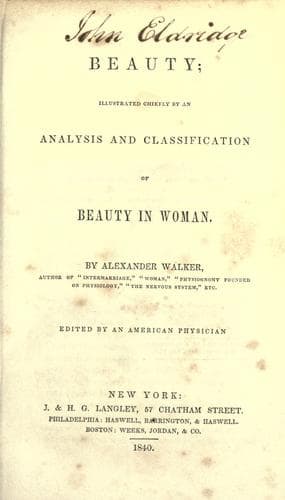
Beauty: Illustrated Chiefly by an Analysis and Classification of Beauty in WomanWalker, Alexander
Philosophy
Beauty: Illustrated Chiefly by an Analysis and Classification of Beauty in Woman
Walker, Alexander
Beauty, Personal; Women
If, in a living body, any part liable to be distended had too much
firmness, or even elasticity, it might press against some essential organ;
and the liquids being impeded in their course, would in that case be
speedily altered, if the neighboring parts offered not flexible vessels
for their reception.
Now, in the body of woman, certain parts are exposed to suffer great
distentions and compressions. It is therefore necessary that her organs
should be of such structure as to yield readily to these impressions, and
to supply each other when their respective functions are impeded.
From this it follows, that woman never enjoys existence better, than when
a moderate plumpness bestows on her organs, without too much weakening
them, all the suppleness of which they are capable.
This leads to the consideration of the natural mobility of the organs of
woman.
Their mobility is a necessary consequence, in the first place, of their
littleness. The movements of all animals, appear to be executed with more
rapidity, the less their bulk. It has been observed, that the arteries of
the ox beat only thirty-five times, while those of the sheep beat sixty,
and that the pulse of women is smaller and more rapid than that of men.
A second physical quality, which concurs to render more mobile the
various parts of woman, is their softness.
A certain feebleness is the necessary consequence of these two
circumstances. But it is thence that spring woman's suppleness and
lightness of movement, and her capacity for grace of attitude.
It has been conjectured, that even the elements of the parts which
constitute woman, have a particular organization, on which depends the
elegance of the forms, the vivacity of the sensations, and the lightness
of the movements, which characterize her.
The result of these circumstances is that, while man possesses force and
majesty, woman is distinguished by beauty and grace. The characteristics
of woman are less imposing and more amiable; they inspire less admiration
than love. As has been observed, a single trait of rudeness, a severe air,
or even the character of majesty, would injure the effect of womanly
beauty. Lucian admirably represents to us the god of love frightened at
the masculine air of Minerva.
While man, by force and activity, surmounts the obstacles which embarrass
him, woman, by yielding, withdraws from their action, and adds to beauty,
a gentle and winning grace which places all the vaunted power of man at
her disposal.
It is evidently the influence of the organs distinguishing the two sexes,
which is the primary cause of their peculiar beauty.
Public-domain text, read in full here on John Shaqi.
Reviews
Reviews
No reviews yet
Be the first to share your thoughts on this work.
Elsewhere in the archive
Join the Discussion
Join the discussion
Sign in to leave a comment or review.
Sign InorCreate an account