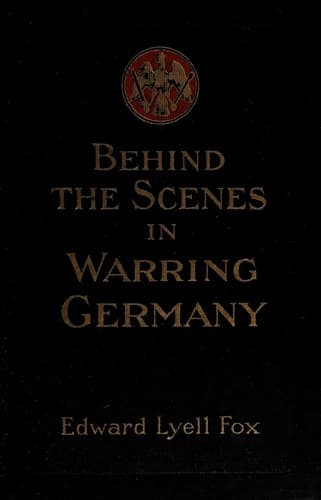
Behind the Scenes in Warring GermanyFox, Edward Lyell
History
Behind the Scenes in Warring Germany
Fox, Edward Lyell
World War, 1914-1918 -- Personal narratives
The road tunneled through a vista of trees. We passed another peasant
family--a father and a mother bearing packs, three children, one
carrying a bird cage in which there was no bird. They too were on the
heels of the retreat, only they were going back to the homes which they
had fled in those terrifying November days when the Russians had overrun
the land ... going back to what?
The sledge had stopped. A scrawny girl held the cow by a rope. As our
searchlight glared into their faces, the children, piled among the
household goods, frowned and blinked. The man was holding the horse. The
woman was staring off into the night.
Our gaze followed hers. Our headlight was shining on a roofless house
with charred windows as the empty sockets of a skull and revealed the
outlines of a jagged wall that had been the barn, and a huddle of fence
palings and soft earth, once the garden. The woman who sat with her
children on the loaded sledge, must have sobbed--although we could not
hear it above the motor's din--for the man holding the horse turned, and
the girl holding the cow turned, and the frowning, blinking children
turned in her direction. And after we had passed we looked back and
they were standing there in the same postures, transfixed, gazing at the
blackened chaos once their home.
* * * * *
There are many villages between Kowahlen and the frontier--the villages
of Lukellen, Drosdowen and Mierunsken. But to-day they are only names by
which may be characterized certain works of Russian arson. Not a house
did we find intact on this road to the frontier, not a home but that was
ashes or if of stone whose walls were black. Not even the church at
Mierunsken had escaped the torch. In a few moments more we were in
Russia. We did not need the striped frontier posts to confirm this; nor
the holes and lumps, that marked the end of German road building.
Something more significant revealed to us that at last we had come to
the land of the Bear. For we passed through two villages but a kilometer
apart and in these not a house had been burned, not even a fence
smashed; they were Amt and Filipowa, in the Czar's domain.
"Rittmeister," I asked, "did German soldiers follow the Russians down
this road?"
"All the way to Suwalki," replied Tzschirner.
"German soldiers," I persisted, "who passed through Goldap and all those
villages to the frontier."
"Naturlich. That was the line of advance."
I was silent.
"Rittmeister, you have wonderful discipline in your army."
Tzschirner seemed surprised. "Why?"
"I cannot understand," I said, "how your soldiers, seeing what the
Russians had done to East Prussian villages, could refrain from taking
vengeance on the first Russian village they entered."
I think the Rittmeister was a little offended.
"We are soldiers," he said with dignity; "not criminals." He paused and
perhaps guessing that Belgium was in my mind, "We only make war on
non-combatants when they make war on us."
Public-domain text, read in full here on John Shaqi.
Reviews
Reviews
No reviews yet
Be the first to share your thoughts on this work.
Elsewhere in the archive
Join the Discussion
Join the discussion
Sign in to leave a comment or review.
Sign InorCreate an account