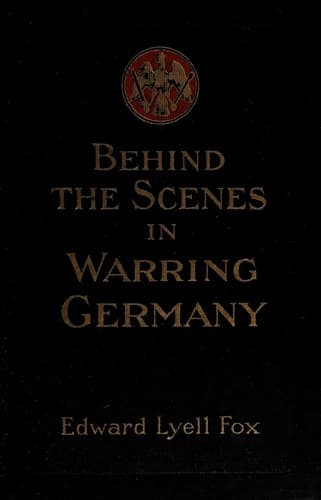
Behind the Scenes in Warring GermanyFox, Edward Lyell
History
Behind the Scenes in Warring Germany
Fox, Edward Lyell
World War, 1914-1918 -- Personal narratives
* * * * *
Near Jemieliste we overtook the army. Visible at the extremity of our
long, yellowish light, there grew out of the darkness, the grayish tops
of transports, rolling as on a sea; and as we came up with them we
distinguished in their muffled clamor, the clanking of chains, the cries
of the drivers and the cracking of whips on the horses' backs.
Throttling down until we barely crept along, our soldier chauffeur
dexterously guided the car between the maze of wagon wheels and balking
horses, so on, until after I had counted twenty wagons struggling hub
deep through the frozen snow, we came to the head of the column, where
the serene officer, utterly oblivious to the confusion behind him,
leisurely rode the lead. And I thought of that other great general who
dared the Russian snows without railroads and all that modern science
has given war, penetrating the land to Moscow and across such frightful
roads through the heart of the Russian winter; in that night one was
awed with the name Napoleon.
The yelling of the transport men died away. The gloom thickened; rain
fell. Milanowizizna passed, a ghostly village. Torn, by heavy wagons,
furrowed and frozen into icy ridges, the road became almost impassable.
It was like going over a huge washboard, with the corrugations running
in crisscrosses. Jumping insanely from ridge to hole, our motor stood up
wonderfully, until we came to an abrupt hill where nubbles of frozen
snow impeded the way. Three times did Gelbricke, the chauffeur, try to
make it; and three times the wheels spun helplessly. Finally with
reluctance the Rittmeister said it would be better if we all got out.
And then in the pitch darkness and cold rain, we put our shoulders to
the car, but with futile effort.
"Let's find some wood for treads," I suggested.
The Rittmeister would have none of it. He seemed to be mortified that we
should be put to this inconvenience while guests of the German army.
"Seyring!" he called the mechanician by name.
"_Jawohl._"
Of course, out on a Russian plain, in pitch darkness, it was quite easy
to find wood; but one thought that Seyring's "Jawohl" would have been
equally as cheery had the Rittmeister ordered him to find a bottle of
wine.
I too went to find wood. Only my foot stumbled against something in the
ditch and I almost fell upon it. And when I flashed on my electric torch
I saw that it was a Russian soldier. His face was buried in the snow,
his stiff, extended arms pawing the frozen ground. On the shoulders of
his long brown coat I read the number of his regiment, 256, and on his
feet, from which the boots had been stripped, were wound with strips of
knitted wool. His black, bare head, intensified by the contrasting snow,
seemed the blackness of a raven.... The others found the wood.
Public-domain text, read in full here on John Shaqi.
Reviews
Reviews
No reviews yet
Be the first to share your thoughts on this work.
Elsewhere in the archive
Join the Discussion
Join the discussion
Sign in to leave a comment or review.
Sign InorCreate an account