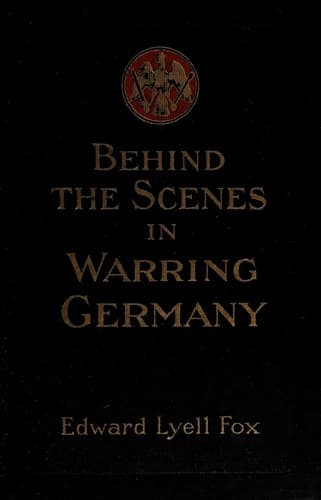
Behind the Scenes in Warring GermanyFox, Edward Lyell
History
Behind the Scenes in Warring Germany
Fox, Edward Lyell
World War, 1914-1918 -- Personal narratives
"During our drive on Paris," he said, "the French would often succeed in
covering a segment of road with their long range artillery, and
continually drop shells upon it. They knew, of course, that our
infantry, by making a detour through the fields, could avoid this death
zone, but they shelled on, knowing that our transport trains would have
to go by the road. So the transports would make a rush for it, and of
course many were killed."
Another mile passed without our seeing any more of the gray wagon
trains, and now the distant artillery grumbled louder. Two Uhlans
cantered by, scanning us, and further on we passed another patrol. A
corral of the familiar gray-topped wagons beside red brick farm
buildings showed the location of a base of supplies, and in front of the
house we saw a naked soldier unconcernedly scrubbing himself in a tub of
water. And always the sullen roaring guns grew steadier and more
disconcertingly clear.
"On this section of the line," Ober-Lieutenant explained, "the Staff
told me that the French generally begin their heaviest firing every day
at half past three."
I asked him why that was--it was like the curtain going up in a theater
at a certain time. But he did not know, and could not even guess. I was
wondering how much further we were going to rush towards that unearthly
booming when at a muddy crossroad, patrolled by a Uhlan, as motionless
as Remington might have painted him, we made a quick turn and plowed
away. Apparently we were bound for a weather-beaten house and barn, half
hidden by a leafless clump of willows, apparently shorn by shrapnel, for
the broken branches hung down dead in a perfect arc as though the
projectile had burst, perhaps right there above the tiny moss-banked
stream, and sprayed its leaden shower.
As our motor, which had been heavily crawling along the farmhouse lane,
finally sogged in the mud, refusing to go further, I followed
Ober-Lieutenant Herrmann out of the machine, across the yard to where a
sentry stood before the barn door. They exchanged words and then the
barn door slid back a trifle, a youngish man, wearing the black leather
helmet and coat of the aviation corps, appearing in the aperture.
Excusing himself, Herrmann drew him aside and now and then I heard their
voices raised in assent; they were evidently discussing my proposed
flight. I guessed that Herrmann wanted to know exactly how much danger
there would be. Conjecturing that he was apparently satisfied that the
risk was a minimum, and that the aviator had been instructed to bring
me nowhere near the firing line, I waited for their conference to break
up.
Public-domain text, read in full here on John Shaqi.
Reviews
Reviews
No reviews yet
Be the first to share your thoughts on this work.
Join the Discussion
Join the discussion
Sign in to leave a comment or review.
Sign InorCreate an account