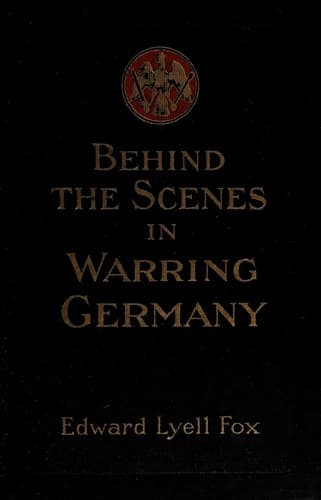
Behind the Scenes in Warring GermanyFox, Edward Lyell
History
Behind the Scenes in Warring Germany
Fox, Edward Lyell
World War, 1914-1918 -- Personal narratives
"Three days and how many lives?" I thought, as we approached the brick
wall, "and now it is not considered of enough importance to have a
single soldier on guard"; which is one of the false impressions that
always comes to you after hearing that a certain point was taken at such
sacrifice, and then to find that point abandoned. For the moment you
seem to think of it as being typically futile of war; and then its place
in the vast strategical contemplation of a battle line three hundred
miles long emerges from your temporarily befogged vision. It is the
military point of view to think that too much peace makes a nation soft,
and you become angry at the feeling that has whispered that war is
futile and forthwith you place war where the idealists forget that it
belongs, not beside barbarism, but with civilization.
We entered by the rusted iron gate and stood among the place of
desecrated graves. But as I walked among them, their white monuments
chipped with rifle balls, the leafless boughs of the great trees
overspreading above splintered with shrapnel, the red wall torn open
here and there to admit the shells that must have burst in that
rain-filled crater by the iron-railed shaft; as I saw a clutter of rifle
butts, smashed off against a tombstone, perhaps, so that the metal parts
could be taken back to an ordnance factory to be molded again, I was
thinking of the men who had fought here, and whether they had lived. I
was wondering how many of those thick, white, bullet-chipped tombstones
had shielded men from death. I was wondering how many more of them would
have been killed had they fought in the open field; and as I examined
the shattered granite slabs, I thought of the protection they had given.
One of the staff officers was speaking to me. "Will you return to
headquarters with us for tea?" he was saying, and he gave a slight
shudder. Perhaps it was from the cold rain.
As we motored into Vis en Artois, the sun broke through the gray-ringed
dreariness of sky. Up a narrow hill street with the powerful car waking
the echoes among the low white stone houses, two or three peasants in
wooden shoes flattening themselves against the walls to escape the muddy
spray from our tires, and we stopped in what seemed to be the village
center. Down the street I could see the last hooped roof of a transport
caravan, and from a stealthy creaking in the house across the street, I
had an idea that shutters were being slowly pushed open and that there
were frightened, bewildered eyes behind.
With Ober-Lieutenant Herrmann, whose French is better than mine, I
crossed the street to read the proclamation--_Avis!_--pasted to the wall
of a church. Worded by the Germans and signed by the French Burgomaster
of Vis en Artois, it told the inhabitants what to do if they would keep
out of trouble.
Public-domain text, read in full here on John Shaqi.
Reviews
Reviews
No reviews yet
Be the first to share your thoughts on this work.
Join the Discussion
Join the discussion
Sign in to leave a comment or review.
Sign InorCreate an account