Autobiographies; Boys -- Biography; Country life; New England
The fact is, that the boy is as good in the buttery as in any part
of farming. His elders say that the boy is always hungry; but that is
a very coarse way to put it. He has only recently come into a world
that is full of good things to eat, and there is on the whole a very
short time in which to eat them; at least he is told, among the first
information he receives, that life is short. Life being brief, and pie
and the like fleeting, he very soon decides upon an active campaign. It
may be an old story to people who have been eating for forty or fifty
years, but it is different with a beginner. He takes the thick and thin
as it comes, as to pie, for instance. Some people do make them very
thin. I knew a place where they were not thicker than the poor man's
plaster; they were spread so thin upon the crust that they were better
fitted to draw out hunger than to satisfy it. They used to be made up
by the great oven-full and kept in the dry cellar, where they hardened
and dried to a toughness you would hardly believe. This was a long time
ago, and they make the pumpkin-pie in the country better now, or the
race of boys would have been so discouraged that I think they would
have stopped coming into the world.
The truth is, that boys have always been so plenty that they are
not half appreciated. We have shown that a farm could not get along
without them, and yet their rights are seldom recognized. One of the
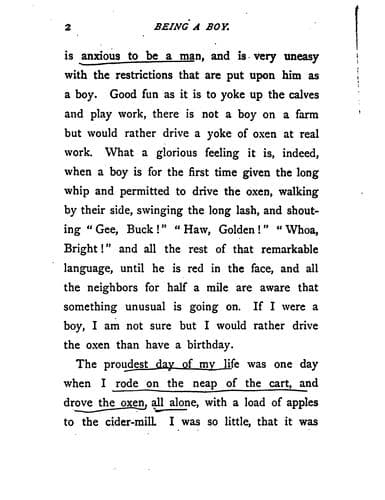
most amusing things is their effort to acquire personal property. The
boy has the care of the calves; they always need feeding or shutting
up or letting out; when the boy wants to play, there are those calves
to be looked after,—until he gets to hate the name of calf. But in
consideration of his faithfulness, two of them are given to him. There
is no doubt that they are his; he has the entire charge of them. When
they get to be steers, he spends all his holidays in breaking them in
to a yoke. He gets them so broken in that they will run like a pair
of deer all over the farm, turning the yoke, and kicking their heels,
while he follows in full chase, shouting the ox language till he is
red in the face. When the steers grow up to be cattle, a drover one
day comes along and takes them away, and the boy is told that he can
have another pair of calves; and so, with undiminished faith, he goes
back and begins over again to make his fortune. He owns lambs and young
colts in the same way, and makes just as much out of them.
Public-domain text, read in full here on John Shaqi.
Reviews
Reviews
No reviews yet
Be the first to share your thoughts on this work.
Join the Discussion
Join the discussion
Sign in to leave a comment or review.
Sign InorCreate an account