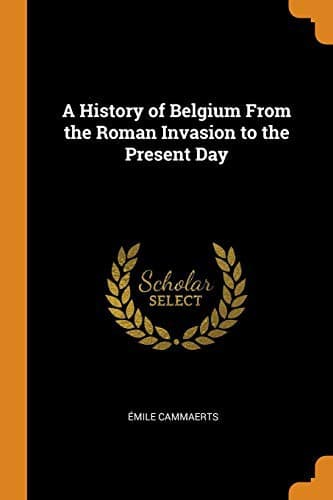
Belgium: From the Roman Invasion to the Present DayCammaerts, Emile
History
Belgium: From the Roman Invasion to the Present Day
Cammaerts, Emile
Belgium -- History
The good faith of the public throughout the Congo campaign is
unquestionable. That of its main engineers is at least open to doubt.
They organized their efforts at the time when the greatest difficulties
of colonization had been overcome. They pursued them after all cause
for abuse had been removed. In one of his first books, _British Case in
French Congo_, Mr. Morel suggests the partition of the Free State
between this country and Germany. In his last books, written during the
war, he warmly champions the internationalization of Central Africa in
order to save the German Colonies. Neither can it be urged that those
two men who roused the conscience of this country against the Congo
atrocities were deeply shocked by more recent and far better
authenticated atrocities committed in Belgium. If they were, the only
remark an impartial observer might venture to make is that their
actions, during the war, scarcely reflected such righteous indignation.
It may be too hasty to conclude from this, and from the close
association of Erzberger, Morel and Casement in the Congo campaign,
that this campaign was engineered by Germany. We do not yet possess all
the documents necessary to establish this fact. We know enough,
however, to deplore that a movement which might have been so beneficial
to all concerned was allowed to fall into the hands of unscrupulous
agitators, who succeeded in estranging for a time Belgium from Great
Britain, and incidentally in marring the last years of the life of one
of the greatest Belgian patriots.
CHAPTER XXVIII
INTELLECTUAL RENAISSANCE
The remarkable revival of Belgian Arts and Letters which followed
shortly after the 1830 Revolution is one of the most striking examples
of the influence exercised by political events on intellectual
activity. For over a century the nation had been devoid of
self-expression, and during the fifteen years of Union with Holland
scarcely any notable works were produced. No doubt this time, being one
of economic recovery, was not favourable to the efflorescence of Art
and Letters, but the intense activity of the period of independence
appears nevertheless as an outburst of national pride and energy. It
seems as if all the strength, subdued during the periods of foreign
domination, had at last found an outlet, as if the Belgians had waited
all these years to assert again their intellectual power, which could
not or would not flourish for the benefit of foreigners.
Illustration: PALACE OF JUSTICE, BRUSSELS.
_Ph. B._
Public-domain text, read in full here on John Shaqi.
Reviews
Reviews
No reviews yet
Be the first to share your thoughts on this work.
Elsewhere in the archive
Join the Discussion
Join the discussion
Sign in to leave a comment or review.
Sign InorCreate an account