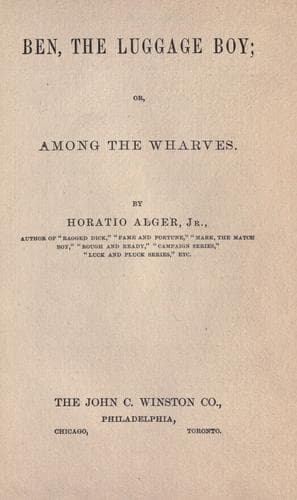
Ben, the Luggage Boy; Or, Among the Wharves — John Shaqi
Ben, the Luggage Boy; Or, Among the WharvesAlger, Horatio, Jr.
History
Ben, the Luggage Boy; Or, Among the Wharves
Alger, Horatio, Jr.
New York (N.Y.) -- History -- Fiction; Runaways -- Fiction
Ben had a pleasant face, and would be considered good-looking. But there
was a flash in his eye, when aroused, which showed that he had a quick
temper, and there was an expression of firmness, unusual to one so
young, which might have been read by an experienced physiognomist. He
was quick-tempered, proud, and probably obstinate. Yet with these
qualities he was pleasant in his manners, and had a sense of humor,
which made him a favorite among his companions.
His father was a coal-dealer in a town a few miles distant from
Philadelphia, of a hasty temper like Ben himself. A week before he had
punished Ben severely for a fault which he had not committed. The boy's
pride revolted at the injustice, and, young as he was, he resolved to
run away. I suppose there are few boys who do not form this resolution
at some time or other in their lives; but as a general thing it amounts
to nothing. With Ben it was different. His was a strong nature, whether
for good or for evil, and when he decided to do anything he was not
easily moved from his resolve. He forgot, in the present case, that,
though he had been unjustly punished, the injustice was not intentional
on the part of his father, who had been under a wrong impression
respecting him. But right or wrong, Ben made up his mind to run away;
and he did so. It was two or three days before a good opportunity
presented itself. Then, with a couple of shirts and collars rolled up in
a small bundle, he made his escape to Philadelphia, and after roaming
about the streets for several hours he made his way to the wharves,
where he found a vessel bound for New York. Representing to the captain
that he lived in New York, and had no money to pay his passage home,
that officer, who was a good-natured man, agreed to carry him for
nothing.
The voyage was now over, and Ben landed, as we have said, an utter
stranger, with very indefinite ideas as to how he was to make his
living. He had told the captain that he knew his way home, for having
falsely represented that he lived in New York, he was in a manner
compelled to this additional falsehood. Still, in spite of his
friendless condition, his spirits were very good. The sun shone
brightly; all looked animated and cheerful. Ben saw numbers of men at
work about him, and he thought, "It will be a pity if I cannot make a
living."
He did not care to linger about the wharf, for the captain might be led
to doubt his story. Accordingly he crossed the street, and at a venture
turned up a street facing the wharf.
Ben did not know much about New York, even by report. But he had heard
of Broadway,--as who has not?--and this was about all he did know. When,
therefore, he had gone a short distance, he ventured to ask a
boot-black, whom he encountered at the corner of the next block, "Can
you tell me the shortest way to Broadway?"
"Follow your nose, Johnny," was the reply.
Public-domain text, read in full here on John Shaqi.
Reviews
Reviews
No reviews yet
Be the first to share your thoughts on this work.
Join the Discussion
Join the discussion
Sign in to leave a comment or review.
Sign InorCreate an account