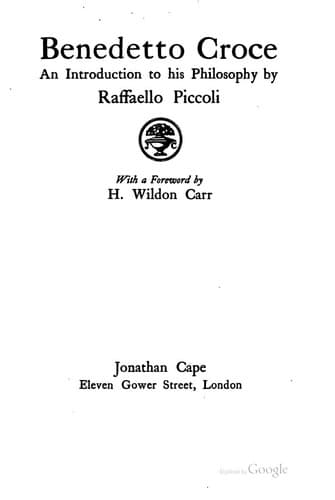
Benedetto Croce: An Introduction to His PhilosophyPiccoli, Raffaello
Philosophy
Benedetto Croce: An Introduction to His Philosophy
Piccoli, Raffaello
Aesthetics; Croce, Benedetto, 1866-1952
One of the most original developments of Croce's thought--a doctrine
that does not owe its validity only to its connection with the system,
since we can find it adumbrated already in such widely divergent
philosophies as those of Socrates and Thomas Aquinas, of Descartes
and Rosmini, but which in Croce's system acquires a new and wider
meaning--is the theory of the practical origin of theoretical error,
which we shall briefly discuss in this chapter.
From a strictly logical standpoint, every error is mere privation or
negativity, the opposite of the logical value which is truth, and
therefore inexistent outside the moment of opposition. As there are
not two values in æsthetics, the beautiful and the ugly, but one only,
beauty or expression, of which ugliness or non-expression is merely the
negative aspect, so in logic also there is but one value, thought or
truth, and error is non-thought, that which logically has no being or
reality. There is no thought which is not a thinking of truth.
Let us pause for one instant to consider this last proposition, which
at first sight undoubtedly has a somewhat paradoxical air. And yet it
is impossible not to accept it, unless we are willing to fall into the
most radical scepticism, which would imply a renunciation not only of
every form of thought, but even, since there is no action which is not
founded on knowledge, of every kind of action. If we believed that
it were possible for our thought to think that which is not true, no
external criterion or standard of truth could even be substituted for
that which thought intrinsically would lack, since the apprehension
of such external standards would in itself be an act of thought, and
therefore suffer from the indetermination and uncertainty of thought
itself. This belief in the validity of human thought is in fact,
however disguised or even openly denied, present in every thinking
and acting being: every thought, every action of man is an implicit
declaration of this faith. And once we have consciously acquired it,
as an inalienable, intrinsic characteristic of our whole spiritual
activity, it is evident that it leaves no place for faith as such, for
an obscure, independent faculty, a mystical intuition, different from
and superior to our human thought, and which could mysteriously endow
thought itself with the gratuitous gift of truth.
Public-domain text, read in full here on John Shaqi.
Reviews
Reviews
No reviews yet
Be the first to share your thoughts on this work.
Elsewhere in the archive
Join the Discussion
Join the discussion
Sign in to leave a comment or review.
Sign InorCreate an account