Beneficiary Features of American Trade Unions — John Shaqi
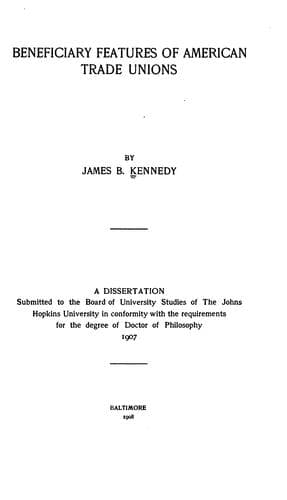
Beneficiary Features of American Trade UnionsKennedy, James Boyd
History
Beneficiary Features of American Trade Unions
Kennedy, James Boyd
Fraternal insurance -- United States; Labor unions -- United States
The history of trade-union beneficiary activities in the United States
may be roughly divided into three periods. In the first, extending from
the beginning of the century to about 1830, the local associations laid
great stress on their beneficiary functions. The societies of printers
organized from 1794 to 1815 in the most important American cities were
typical of the period. In all of them, as far as the extant records
show, the beneficiary functions were regarded as equally important with
the trade-regulating activities. American trade unionism owed its origin
as much to the desire to associate for mutual insurance as to the desire
to establish trade rules.
The second period, from 1830 to 1880, was marked by the subordination of
beneficiary to trade purposes. The maintenance of a minimum rate and
other trade policies came to occupy the foremost place in the program of
the local unions. In this period national unions were formed in many
trades.
The new national unions were not strong enough to establish beneficiary
systems. Moreover, at many points the establishment of local benefits
conflicted with the success of the national organizations. A local union
was usually forced to impose certain restrictions upon claimants of
benefits, either an initiation fee or a requisite term of membership, in
order to protect its funds. Such limitations on the full participation
of all members in the benefits of membership militated severely against
the carrying out of the prime function of the national unions--the
nationalization of membership. The leaders in the trade-union movement
of this period were interested chiefly in strengthening the relations of
the local unions. They saw, therefore, in the local benefits a hindrance
to the accomplishment of their aims. By 1860 it had become a fairly well
accepted doctrine that a trade union should not attempt to develop
beneficiary functions. It was argued that since the expense of
maintaining benefits made the dues of members higher, persons who might
otherwise join the unions were prevented from doing so. The leaders of
the Iron Molders for years opposed the introduction of beneficiary
features on the ground that the development of such activities was
likely to interfere with the trade functions of the organization. In
1866 President Sylvis for this reason vigorously opposed the
introduction of a national sick benefit.[2] As late as 1895 the veteran
president of the Iron Molders--Mr. Martin Fox--counselled the Union
against developing an extensive beneficiary system.[3] The same views
were entertained by the leaders of the other more important unions of
the period.
[Footnote 2: Iron Molders' Journal, Vol. I, p. 309.]
[Footnote 3: Proceedings of the Twentieth Session, 1895, Report of the
President.]
Public-domain text, read in full here on John Shaqi.
Reviews
Reviews
No reviews yet
Be the first to share your thoughts on this work.
Join the Discussion
Join the discussion
Sign in to leave a comment or review.
Sign InorCreate an account