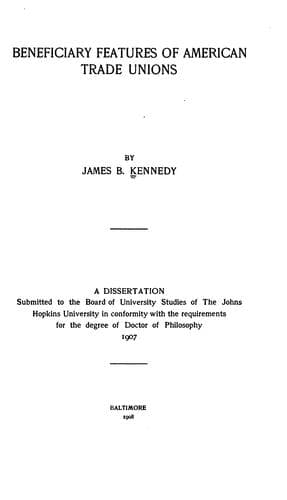
Beneficiary Features of American Trade Unions — John Shaqi
Beneficiary Features of American Trade UnionsKennedy, James Boyd
History
Beneficiary Features of American Trade Unions
Kennedy, James Boyd
Fraternal insurance -- United States; Labor unions -- United States
The new system differs in two important respects from the old. In the
first place, the rates are graded according to age, and secondly, the
new system provides that a member may retire five years after entrance,
or thereafter at any successive period of five years up to seventy, and
that his premiums shall be fixed according to the time of retirement and
the period of his expectancy.
The disability certificates provide for an indemnity of eight dollars
per week for loss of time resulting from disability caused by accident
or sickness, a maximum of twenty weeks' disability during any one
year.[58] However, should a member, after entrance into the association,
become disabled permanently by "tuberculosis, paralysis, locomotor
ataxia, dropsy, cancer, diabetes, sciatica, chronic rheumatism, chronic
kidney or mental disease, or any other chronic disease," not especially
named in the constitution, that may, in the judgment of the board of
directors, cause permanent drain upon the funds of the Association, the
said member shall receive the disability allowance for twenty weeks,
after which all payments shall cease and his certificate shall be
cancelled.[59] The disability insurance is thus really sick insurance.
[Footnote 58: The Postal Record, Vol. 17, p. 6.]
[Footnote 59: Constitution 1905, Art. 12, in The Postal Record, Vol. 19,
pp. 2-6.]
To aid members who are too old to take advantage of the plan offered for
securing annuities by their own financial efforts, the Association, in
convention at Portland, September, 1905, endorsed an "extended leave of
absence retirement plan."[60] The Post Office Department of the United
States was requested to grant an extended leave of absence to
"superannuated or permanently impaired" carriers on condition that they
accept 40 per cent. of their regular salary, while retired, and that
they pay the remaining 60 per cent. to the senior substitute in their
office. Under the conditions of this plan, the applicant for retirement
must submit himself to the board of examiners, who shall, after a
physical examination by the physician of the board, determine his
eligibility. The results of this plan would be two-fold: first, to
relieve the detrimental effect of superannuation upon the efficiency of
the service, and, secondly, to remove the fear of those who look for
more drastic measures of relief. Aside from a regular pension grant by
the Government this plan is considered the most efficient method of
securing adequate protection for the superannuated who are too old to
avail themselves of the opportunities offered under the system of
annuities.[61]
[Footnote 60: The Postal Record, Vol. 18, pp. 220-222.]
[Footnote 61: The Postal Record, Vol. 19, p. 6.]
Public-domain text, read in full here on John Shaqi.
Reviews
Reviews
No reviews yet
Be the first to share your thoughts on this work.
Join the Discussion
Join the discussion
Sign in to leave a comment or review.
Sign InorCreate an account