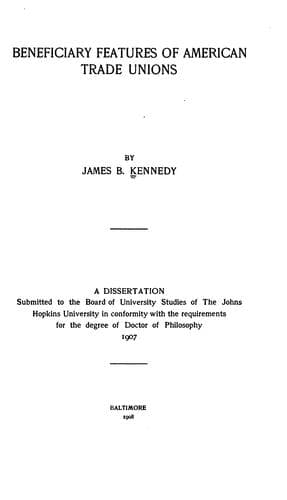
Beneficiary Features of American Trade UnionsKennedy, James Boyd
History
Beneficiary Features of American Trade Unions
Kennedy, James Boyd
Fraternal insurance -- United States; Labor unions -- United States
The Brotherhood of Railroad Trainmen, the Order of Railroad
Telegraphers, the Switchmen's Union, and the Maintenance-of-Way
Employees did not pass through the first period of development, but were
organized during the second stage when the amount of insurance was
limited. The Trainmen, the Telegraphers, and the Switchmen, in their
first constitutions of 1883, 1887 and 1886, respectively, and the
Trackmen (Maintenance-of-Way Employees) in 1892 fixed the amount paid at
the definite sums of $300, $1000, $500 and $1000, respectively.[67] The
Letter Carriers, although organized after the railway unions had fixed
at a definite sum the amount of insurance to be paid, for several years
paid only a sum equivalent to one assessment, at the regular rates, upon
all the certificates in force at the time of the death of the
insured.[68] The amounts paid on the second death, March 22, 1892, and
on the third death, July 28, 1893, were $599.16 and $596.12,
respectively.[69] Finally, in the third period, from 1890 to the
present, the number of assessments was also fixed.
[Footnote 67: Constitutions for the several years. Reference is made to
the Trackmen's Constitution, 1893 (n.p. n.d.); Proceedings of the Second
Annual Convention, 1893, in Advance Advocate, Vol. 2.]
[Footnote 68: The Postal Record, Vol. 5, p. 185.]
[Footnote 69: _Ibid_., Vol. 5, p. 138.]
Another important change in the method of conducting these insurance
systems was made in the decade from 1890 to 1900. The organizations with
two exceptions have not adopted the policy of the insurance companies in
varying the charge with the age of the insured. The device they have
commonly used is the differentiation in the amount of insurance which
may be taken in such a way that the older members may insure themselves
only for a smaller amount. As early as 1886 the Firemen provided that
only members under forty-five years of age might take insurance,[70] and
in 1887 the Telegraphers adopted an age limit of fifty years.[71] The
Conductors, under the constitution of 1890, provided that any member
between the ages of fifteen and fifty might take $2500 of insurance
against death or disability, and any member between the ages of fifty
and sixty might take $1000 against death and $500 against
disability.[72] In 1892 the Engineers introduced an age limit of fifty,
and in 1894 further differentiated applicants so that those under forty
years of age might secure $4500, those under forty-five years of age
might obtain $3000, and all over forty-five and under fifty years of
age, $1500.[73] Even now the Switchmen and the Trainmen offer equal
amounts to members of all ages at the same rate.
[Footnote 70: Constitution, 1886 (Terre Haute, n.d.), sec. 71.]
[Footnote 71: Constitution, 1887, Arts. 12-13, in the Railroad
Telegrapher, Vol. 2.]
[Footnote 72: Constitution, 1888, second edition (Rochester, 1890), p.
38.]
[Footnote 73: Constitution, 1894 (Peoria, 1895).]
Public-domain text, read in full here on John Shaqi.
Reviews
Reviews
No reviews yet
Be the first to share your thoughts on this work.
Join the Discussion
Join the discussion
Sign in to leave a comment or review.
Sign InorCreate an account