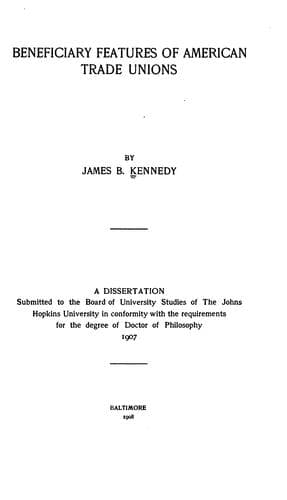
Beneficiary Features of American Trade Unions — John Shaqi
Beneficiary Features of American Trade UnionsKennedy, James Boyd
History
Beneficiary Features of American Trade Unions
Kennedy, James Boyd
Fraternal insurance -- United States; Labor unions -- United States
In all the organizations there is a class of members, called
non-beneficiary, who are not eligible to the insurance departments
because of partial disability or because of having passed the age limit.
The Brotherhood of Locomotive Firemen provides that the non-beneficiary
member shall be entitled to all the privileges of the subordinate lodge,
but shall not take part in the national convention or in any way
participate in the benefits and privileges of the beneficiary
department.[82] Similar rules are found in the other brotherhoods. The
Trainmen and the Switchmen issue to non-beneficiary members insurance
certificates only against death in the sums of $500 and $600,
respectively.
[Footnote 82: Constitution, amended 1902 (Peoria, n.d.), sec. 163.]
The efficiency of compulsory insurance rules in securing and retaining
members in the brotherhoods is generally acknowledged among the railway
employees. After the member has carried insurance for several years, his
financial interests are bound up with the interests of the organization,
and his loyalty to the union is increased. From this loyalty flows
greater interest in every phase of the brotherhood's work. The operation
of compulsory insurance appears to have caused an increase in the
membership of the brotherhoods. On January 1, 1890, the date on which
compulsory insurance became operative, the membership of the Brotherhood
of Locomotive Engineers numbered 7408; on January 1, 1897, it had
increased to 18,739; and in May, 1904, to 46,400.[83] On January 1,
1891, the date on which compulsory insurance was inaugurated, the
membership of the Order of Railway Conductors numbered 3933; on January
1, 1898, it had increased to 15,807, and again on January 1, 1904, to
31,288. It is noteworthy that during the depression, 1893-1897, those
organizations having systems of voluntary insurance suffered far more
severely than those enforcing compulsory insurance. Thus, the
Telegraphers were almost annihilated, while the Firemen and the
Conductors practically maintained their position.
[Footnote 83: Locomotive Engineers' Journal, Vol. 37, p. 446; Vol. 18,
p. 654.]
The cost of insurance per $1000 varies greatly in the different
organizations, as may be seen by the following table:[84]
Public-domain text, read in full here on John Shaqi.
Reviews
Reviews
No reviews yet
Be the first to share your thoughts on this work.
Join the Discussion
Join the discussion
Sign in to leave a comment or review.
Sign InorCreate an account