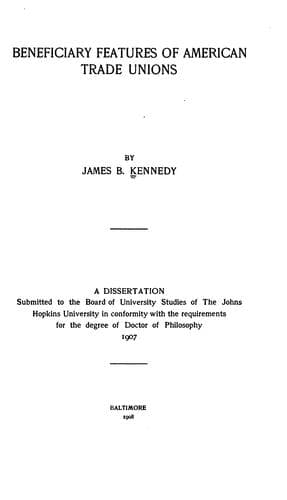
Beneficiary Features of American Trade UnionsKennedy, James Boyd
History
Beneficiary Features of American Trade Unions
Kennedy, James Boyd
Fraternal insurance -- United States; Labor unions -- United States
[Footnote 6: Cigar Makers' Journal, Vol. 10, Aug., 1885; Vol. 19, May,
1894, p. 8. The records of initiations and suspensions for various
periods in the history of the union also show the increase in the power
to retain members. During 1877-1879, with only strike benefits in
operation, 3000 members were initiated and 2750 were suspended; from
September, 1879, to September, 1880, with strike and travelling benefits
in force, 5453 were initiated and 1853, or 33.9 per cent., were
suspended, while from September, 1880, to September, 1881, when a sick
benefit was also being paid, 7402 were initiated, and 1867, or 25.2 per
cent., were suspended. (Cigar Makers' Journal, Vol. 6, June, 1881, p. i;
Vol. 7, October, 1881, p. 3.)]
The Typographia, the only other American trade union which has developed
its system of benefits as fully as the Cigar Makers, held its membership
equally well during the depression of 1893-1897. The following table
shows the membership of the Typographia from 1890 to 1900 by years:
1890 ...1233 1894 ...1204 1898 ...1100
1891 ...1322 1895 ...1092 1899 ...1071
1892 ...1382 1896 ...1115 1900 ...1044
1893 ...1380 1897 ...1083
The falling off in membership in 1894 and 1895 was due only to a very
small extent to defections. The introduction of the linotype decreased
the opportunity for employment in the trade, and the gradual shrinkage
in the amount of German printing done in the United States due to the
falling off in German immigration was accentuated by the depression.
While the two unions having the most highly developed beneficiary
systems thus show an ability to retain members during periods of
depression, it would be absurd to assume that this result is solely the
effect of the establishment of the benefits. The Cigar Makers' Union in
1892 would undoubtedly have held its membership better than it did in
1872 even if it had developed no benefits. It is interesting in this
connection to note that while in the depression of 1873-1878 the
membership of the Typographical Union fell from 9799 to 4260, a loss of
forty per cent., and the number of local unions decreased from 105 to
60, in the great depression of 1893-1897 the membership fell from 31,379
in 1894 to 28,096 in 1897, a loss of only ten per cent. Part even of
this small loss was due to the withdrawal of the pressmen and
bookbinders from the organization. It thus appears that the
Typographical Union with a death benefit of sixty-five dollars and a
home for the aged held its membership almost as well as the Cigar Makers
with their much more highly developed beneficiary system. The change in
the power of the Typographical Union to retain its membership was
obviously due not so much to the establishment of beneficiary features
as to the greater support which it gave its members in collective
bargaining.
Public-domain text, read in full here on John Shaqi.
Reviews
Reviews
No reviews yet
Be the first to share your thoughts on this work.
Join the Discussion
Join the discussion
Sign in to leave a comment or review.
Sign InorCreate an account