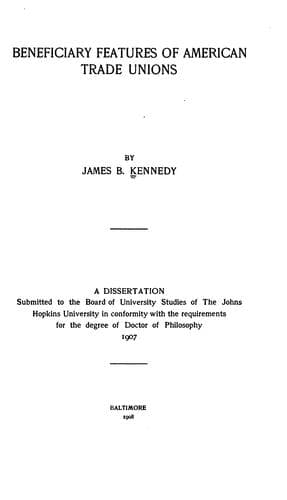
Beneficiary Features of American Trade UnionsKennedy, James Boyd
History
Beneficiary Features of American Trade Unions
Kennedy, James Boyd
Fraternal insurance -- United States; Labor unions -- United States
The Granite Cutters' Union was the first national union to inaugurate a
system of national sick benefits. In its first constitution, 1877,
provision was made for the formation of a voluntary association for the
payment of sick benefits. All members of the Union under fifty-five
years of age were eligible to membership.[122] An initiation fee,
varying from two dollars for members under thirty years of age to six
dollars for those fifty years old, was charged. The amount of the
benefit was fixed at six dollars per week during sickness, without any
limitation on the amount granted during any one year. The association
never had a large membership and was dissolved in 1888. The Union from
1888 to 1897 exempted members during illness from all dues except
funeral assessments; since 1897 members in good standing who have been
sick for two months are exempt from half dues.[123]
[Footnote 122: Constitution, 1877 (Rockland, Maine, 1877), p. 30.]
[Footnote 123: Constitution of the Granite Cutters' International
Association of America, 1888, Art. 38 (New York, 1888); Constitution,
1897 (Baltimore, n.d.), p. 32.]
The Cigar Makers' Union was the first American national trade union to
establish a compulsory sick benefit. The system was put into operation
in 1880.[124] For some years previously sick benefits had been paid by
certain of the local unions, particularly those in New York, New Haven
and Brooklyn. In 1877 the Brooklyn local proposed that the sick benefit
should be nationalized, but the convention defeated the plan.[125] At
the convention of 1878 a committee was appointed to consider the
advisability of establishing a national system of relief. This committee
made a favorable report in 1879, and its plan was finally adopted at the
thirteenth annual session, September, 1880.[126] The success of the sick
benefit was immediate, and in 1881 and 1884 the amount of the allowance
was increased.[127] The popularity of the sick benefit grew rapidly, and
it soon took rank as one of the most successful features of the
organization.[128]
[Footnote 124: Cigar Makers' Journal, Vol. 6, Oct., 1880, p. 7.]
[Footnote 125: _Ibid._, Vol. 3, Oct., 1877, p. 3.]
[Footnote 126: _Ibid._, Vol. 5, June, 1879, p. 1; October, 1880, p. 7.]
[Footnote 127: Constitution, 1881 (New York, 1881), Art. 9.]
[Footnote 128: Cigar Makers' Journal, Vol. 14, August, 1889, pp. 10-11.]
In the first national constitution of the Deutsch-Amerikanischen
Typographia, adopted in April, 1873, provision was made for the payment
of sick benefits by the subordinate unions.[129] The system, however,
was unsatisfactory, and in 1879 and 1881 unsuccessful efforts were made
to remedy its deficiencies. The desire for a better system finally led
to the adoption of a national sick benefit at the New York convention in
May, 1884.
[Footnote 129: 25-jährige Geschichte der Deutsch-Amerikanischen
Typographia, p. 6; American Federationist, Vol. 2, No. 4, p. 60.]
Public-domain text, read in full here on John Shaqi.
Reviews
Reviews
No reviews yet
Be the first to share your thoughts on this work.
Elsewhere in the archive
Join the Discussion
Join the discussion
Sign in to leave a comment or review.
Sign InorCreate an account