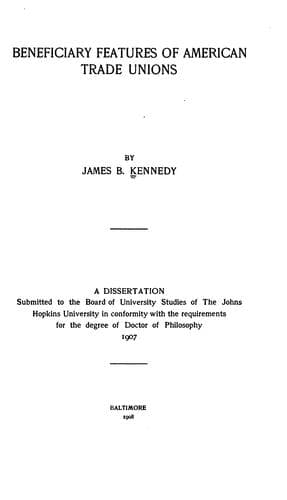
Beneficiary Features of American Trade UnionsKennedy, James Boyd
History
Beneficiary Features of American Trade Unions
Kennedy, James Boyd
Fraternal insurance -- United States; Labor unions -- United States
The unions paying the sick benefit fall into two classes according as
they administer the benefit directly from the offices of the national
union with the aid of the local union or as they intrust the
administration of the benefit to the local union and leave to the
national officers only a general supervision. The Boot and Shoe Workers,
the Barbers and the Tobacco Workers are in the former class, while in
the latter are the Cigar Makers, Iron Molders, Typographia, Plumbers,
Leather Workers on Horse Goods and the Garment Workers.
The chief means relied upon to guard against fraud are the certificate
of the attending physician and the report of a visiting committee of the
local union. Some of the unions require both the certificate and the
report; the larger part, however, rely on the report of the visiting
committee, although local unions are permitted to require that a
physician's certificate shall be furnished. The duties of the visiting
committee are set forth with great elaboration in all the constitutions.
Thus, the Boot and Shoe Workers require that the claim shall be
investigated by "three Union members of good repute not related to the
sick member, each acting independently of the others and reporting
individually to the local executive board." The Plumbers and Cigar
Makers require that every sick member shall be visited at least once in
each week and that no two members of the committee shall visit him at
the same time.
Notwithstanding these precautions it has not been possible entirely to
prevent the payment of fraudulent claims for sick benefits. The visiting
committees of the local unions are frequently neglectful or careless in
exercising their supervisory functions, and occasionally knowingly
sanction the payment of unwarranted claims. Where the unions do not have
an out-of-work benefit, there is always the chance that unemployed
members will claim the sick benefit and that the local unions, aware
that the money for the payment of the claim comes from the national
union, will not scrutinize with any care the severity of the illness.
Reserving to the national officials the right to pass finally upon
sick-benefit claims is not effective as a precaution against such
frauds. The national officials cannot inform themselves as to the
honesty of the physician who signs the certificate nor as to the good
faith with which the visiting committee has performed its duties. On the
whole, the better policy seems to be to place the responsibility of
passing upon individual claims directly upon the local union, and to
reserve to the national officials an oversight of the administration of
the local unions.
Public-domain text, read in full here on John Shaqi.
Reviews
Reviews
No reviews yet
Be the first to share your thoughts on this work.
Elsewhere in the archive
Join the Discussion
Join the discussion
Sign in to leave a comment or review.
Sign InorCreate an account