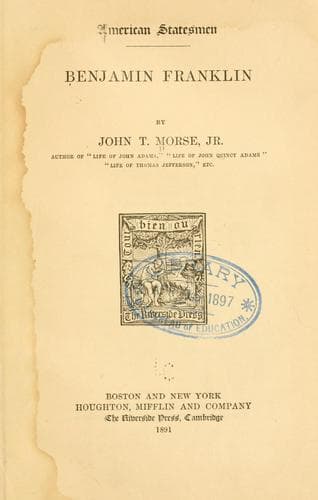
Benjamin FranklinMorse, John T., Jr. (John Torrey)
History
Benjamin Franklin
Morse, John T., Jr. (John Torrey)
Franklin, Benjamin, 1706-1790
It was, however, upon a comparatively trifling matter that Hillsborough
finally lost his place. It has been already mentioned that many years
before this time Franklin had urged the establishment of one or two
frontier, or "barrier," provinces in the interior. He had never
abandoned this scheme, and of late had been pushing it with some
prospect of success; for among other encouraging features he astutely
induced three privy councilors to become financially interested in the
project. The original purpose of the petitioners had been to ask for
only 2,500,000 acres of land; but Hillsborough bade them ask for "enough
to make a province." This advice was grossly disingenuous; for
Hillsborough himself afterward admitted that from the beginning he had
intended to defeat the application, and had put the memorialists "upon
asking so much with that very view, supposing it too much to be
granted." But they, not suspecting, fell into the trap and increased
their demand to 23,000,000 acres, certainly a sufficient quantity to
call for serious consideration. When the petition came before the board
of trade, Lord Hillsborough, who was president of the board, took upon
himself the task of rendering a report. To the surprise of the
petitioners, who had reason to suppose him well inclined, he replied
adversely. The region was so far away, he said, that it would not "lie
within the reach of the trade and commerce of this kingdom;" so far,
also, as not to admit of "the exercise of that authority and
jurisdiction ... necessary for the preservation of the colonies in due
subordination to and dependence upon the mother country." The territory
appeared, "upon the fullest evidence," to be "utterly inaccessible to
shipping," and therefore the inhabitants would "probably be led to
manufacture for themselves, ... a consequence ... to be carefully
guarded against." Also part belonged to the Indians, who ought not to be
disturbed, and settlements therein would of course lead to Indian wars
and to "fighting for every inch of the ground." Further, the occupation
of this tract "must draw and carry out a great number of people from
Great Britain," who would soon become "a kind of separate and
independent people, ... and set up for themselves," meeting their own
wants and taking no "supplies from the mother country nor from the
provinces" along the seaboard. At so great a distance from "the seat of
government, courts, magistrates, etc.," the territory would "become a
receptacle and kind of asylum for offenders," full of crime itself, and
encouraging crime elsewhere. This disorderly population would soon
"become formidable enough to oppose his majesty's authority, disturb
government, and even give law to the other or first-settled part of the
country, and thus throw everything into confusion." Such arguments were
as feeble as they were bodeful. The only point which his lordship really
scored was in reply to Franklin's theory of the protection against the
Public-domain text, read in full here on John Shaqi.
Reviews
Reviews
No reviews yet
Be the first to share your thoughts on this work.
Elsewhere in the archive
Join the Discussion
Join the discussion
Sign in to leave a comment or review.
Sign InorCreate an account