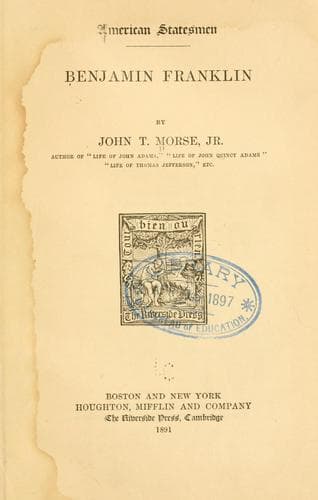
Benjamin FranklinMorse, John T., Jr. (John Torrey)
History
Benjamin Franklin
Morse, John T., Jr. (John Torrey)
Franklin, Benjamin, 1706-1790
Hillsborough's theory was adopted by the board of trade, and Franklin
therefore remained practically stripped of the important agency for
Massachusetts. He anticipated that this course would soon put an end to
all the colonial agencies; but he said that the injury would be quite as
great to the English government as to the colonies, for the agents had
often saved the cabinet from introducing, through misinformation,
"mistaken measures," which it would afterward have found to be "very
inconvenient." He expressed his own opinion that when the colonies "came
to be considered in the light of _distinct states_, as I conceive they
really are, possibly their agents may be treated with more respect and
considered more as public ministers." But this was a day-dream; the
current was setting in quite the opposite direction.
In point of fact, Massachusetts seems to have taken no detriment from
this foolish and captious bit of chicanery. All the papers and arguments
which she had occasion to have presented always found their way to their
destination as well as they would have done if Franklin had been
acknowledged as the quasi public minister, which he conceived to be his
proper character.
Franklin perfectly appreciated that Hillsborough retained his position
by precarious tenure. He shrewdly suspected that if the war with Spain,
which then seemed imminent, were to break out, Hillsborough would at
once be removed. For in that case it would be the policy of the
government to conciliate the colonies, at any cost, for the time being.
This crisis passed by, fortunately for the secretary and unfortunately
for the provinces. Yet still the inefficient and ill-friended minister
remained very infirm in his seat. An excuse only was needed to displace
him, and by a singular and unexpected chance Franklin furnished that
excuse. It was the humble and discredited colonial agent who unwittingly
but not unwillingly gave the jar which toppled the great earl into
retirement. His fall when it came gave general satisfaction. His
unfitness for his position had become too obvious to be denied; he had
given offense in quarters where he should have made friends; he had
irritated the king and provoked the cabinet. Franklin, with his
observant sagacity, quickly divined that George III. was "tired" of
Hillsborough and "of his administration, which had weakened the
affection and respect of the colonies for a royal government;" and
accordingly he "used proper means from time to time that his majesty
should have due information and convincing proofs" of this effect of his
lordship's colonial policy.
Public-domain text, read in full here on John Shaqi.
Reviews
Reviews
No reviews yet
Be the first to share your thoughts on this work.
Elsewhere in the archive
Join the Discussion
Join the discussion
Sign in to leave a comment or review.
Sign InorCreate an account