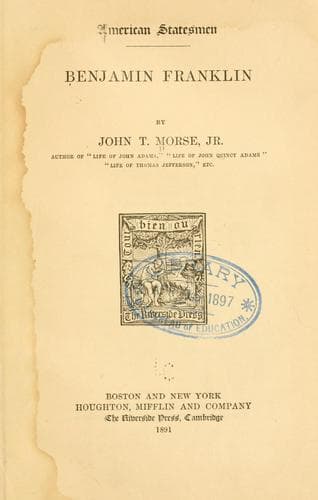
Benjamin FranklinMorse, John T., Jr. (John Torrey)
History
Benjamin Franklin
Morse, John T., Jr. (John Torrey)
Franklin, Benjamin, 1706-1790
Handling the types aroused a boyish ambition to see himself in print. He
scribbled some ballads, one about a shipwreck, another about the capture
of a pirate; but he "escaped being a poet," as fortunately as he had
escaped being a clergyman. James Franklin seems to have trained his
junior with such fraternal cuffs and abuse as the elder brothers of
English biography and literature appear usually to have bestowed on the
younger. But this younger one got his revenges. James published the "New
England Courant," and, inserting in it some objectionable matter, was
forbidden to continue it. Thereupon he canceled the indenture of
apprenticeship, and the newspaper was thereafter published by Benjamin
Franklin. A secret renewal of the indenture was executed simultaneously.
This "flimsy scheme" gave the boy his chance. Secure that the document
would never be produced, he resolved to leave the printing-house. But
the influence of James prevented his getting employment elsewhere in the
town. Besides this, other matters also harassed him. It gives an idea of
the scale of things in the little settlement, and of the serious way in
which life was taken even at its outset, to hear that this 'prentice lad
of seventeen years had already made himself "a little obnoxious to the
governing party," so as to fear that he might soon "bring himself into
scrapes." For the inherited habit of freedom in religious speculation
had taken a new form in Franklin, who was already a free-thinker, and by
his "indiscreet disputations about religion" had come to be "pointed at
with horror by good people as an infidel and atheist"--compromising,
even perilous, names to bear in that Puritan village. Various motives
thus combined to induce migration. He stole away on board a sloop bound
for New York, and after three days arrived there, in October, 1723. He
had but a trifling sum of money, and he knew no one in the strange city.
He sought occupation in his trade, but got nothing better than advice to
move on to Philadelphia; and thither he went. The story of this
journeying is delightfully told in the autobiography, with the famous
little scene wherein he figures with a loaf under each arm and munching
a third while he walks "up Market Street, as far as Fourth Street,
passing by the door of Mr. Read, my future wife's father; when she,
standing at the door, saw me, and thought I made, as I certainly did, a
most awkward, ridiculous appearance."
Public-domain text, read in full here on John Shaqi.
Reviews
Reviews
No reviews yet
Be the first to share your thoughts on this work.
Join the Discussion
Join the discussion
Sign in to leave a comment or review.
Sign InorCreate an account