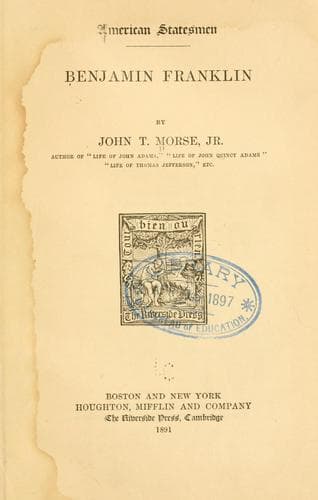
Benjamin FranklinMorse, John T., Jr. (John Torrey)
History
Benjamin Franklin
Morse, John T., Jr. (John Torrey)
Franklin, Benjamin, 1706-1790
Yet in spite of abundant acts, like this, of real independence taking
place upon all sides, profession of it inspired alarm in a large
proportion of the people. Congress even declared formally that
independence was not aimed at. Sam Adams, disgusted, talked of forming a
New England confederacy, and Franklin approved the scheme and said that
in such an event he would cast in his lot with the New Englanders. But
the stream ran on in spite of some snags in the current. It was not much
later that Franklin found himself one of the committee of five elected
by ballot to frame a declaration of independence. Had he been called
upon to write the document he would certainly have given something more
terse and simple than that rotund and magniloquent instrument which
Jefferson bequeathed to the unbounded admiration of American posterity.
As it was, Franklin's recorded connection with the preparation of that
famous paper is confined to the amusing tale about John Thompson,
Hatter, wherewith he mitigated the miseries of Jefferson during the
debate; and to his familiar bonmot in reply to Harrison's appeal for
unanimity: "Yes, we must indeed all hang together, or assuredly we shall
all hang separately." With this rather grim jest upon his lip, he set
his signature to one of the greatest documents in the world's history.
When it came to shaping the machinery of the confederation, the great
difficulty, as is well known, lay in establishing a just proportion
between the larger and the smaller States. Should they have equal weight
in voting, or not? It was a question so vital and so hard to settle that
the confederacy narrowly survived the strain. Franklin was decidedly in
favor of making the voting value proportionate to the size, measured by
population, of the several States. He said: Let the smaller colonies
give equal money and men, and then let them have an equal vote. If they
have an equal vote without bearing equal burdens, a confederation based
on such iniquitous principles will not last long. To set out with an
unequal representation is unreasonable. There is no danger that the
larger States will absorb the smaller. The same apprehension was
expressed when Scotland was united to England. It was then said that the
whale had swallowed Jonah; but Lord Bute's administration came in, and
then it was seen that Jonah had swallowed the whale. That Scotch
favorite was the provocation for many witty sayings, but for none better
than this.
Public-domain text, read in full here on John Shaqi.
Reviews
Reviews
No reviews yet
Be the first to share your thoughts on this work.
Elsewhere in the archive
Join the Discussion
Join the discussion
Sign in to leave a comment or review.
Sign InorCreate an account