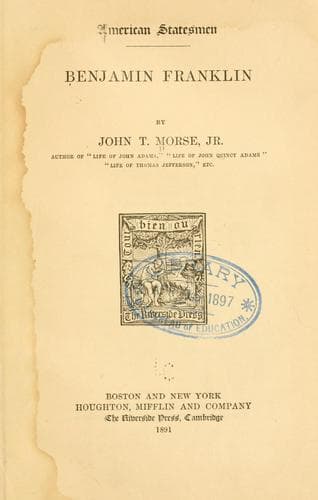
Benjamin FranklinMorse, John T., Jr. (John Torrey)
History
Benjamin Franklin
Morse, John T., Jr. (John Torrey)
Franklin, Benjamin, 1706-1790
In July, 1776, Lord Howe arrived, in command of the English fleet. He
immediately sought to open a friendly correspondence with Franklin. He
had played a prominent part in those efforts at conciliation which had
come to naught just before Franklin's departure from England; and he now
renewed his generous attempt to act as a mediator. There is no doubt
that this nobleman, as kindly as brave, would far rather have reconciled
the Americans than have fought them. By permission of Congress Franklin
replied by a long letter, not deficient in courtesy of language, but
full of argument upon the American side, and in a tone which there was
no misconceiving. Its closing paragraph was:--
"I consider this war against us, therefore, as both unjust and
unwise; and I am persuaded that cool, dispassionate posterity will
condemn to infamy those who advised it, and that even success will
not save from some degree of dishonor those who voluntarily engaged
to conduct it. I know your great motive in coming hither was the
hope of being instrumental in a reconciliation; and I believe, when
you find _that_ impossible on any terms given you to propose, you
will relinquish so odious a command, and return to a more honorable
private station."
If the Englishman had been hot-tempered, this would probably have ended
the correspondence; as it was, he only delayed for a while before
writing civilly again. The battle of Long Island next occurred, and Lord
Howe fancied that that disaster might bring the Americans to their
senses. He paroled General Sullivan, and by him sent a message to
Congress: That he and his brother had full powers to arrange an
accommodation; that they could not at present treat with Congress as
such, but would like to confer with some of its members as private
gentlemen. After a long debate it was resolved to send a committee of
Congress to meet the admiral and the general, and Franklin, John Adams,
and Edward Rutledge were deputed. Lord Howe received them with much
courtesy, and gave them a lunch before proceeding to business. But when
luncheon was over and the substance of the errand was reached, it was
very shortly disposed of. His lordship opened with a speech of elaborate
civility, and concluded by saying that he felt for America as for a
brother, and if America should fall he should feel and lament it like
the loss of a brother. Franklin replied: "My lord, we will use our
utmost endeavors to save your lordship that mortification." But Lord
Howe did not relish this Yankee wit. He continued by a long,
explanatory, conciliatory address. At its close there was necessarily
brought up the question of the character in which the envoys came. His
lordship thought that the idea of Congress might "easily be thrown out
at present." Franklin adroitly settled it: "Your lordship may consider
us in any view you think proper. We on our part are at liberty to
consider ourselves in our real character.
Public-domain text, read in full here on John Shaqi.
Reviews
Reviews
No reviews yet
Be the first to share your thoughts on this work.
Elsewhere in the archive
Join the Discussion
Join the discussion
Sign in to leave a comment or review.
Sign InorCreate an account