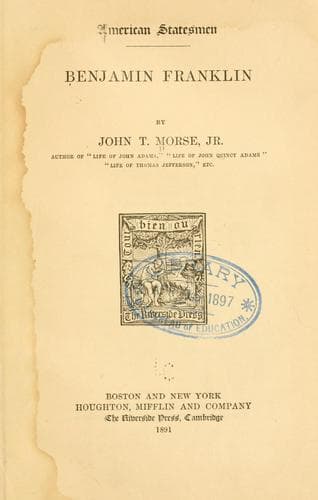
Benjamin FranklinMorse, John T., Jr. (John Torrey)
History
Benjamin Franklin
Morse, John T., Jr. (John Torrey)
Franklin, Benjamin, 1706-1790
On February 6 all was at length ready and the parties came together, M.
Gerard for France and the envoys for the States, to execute these most
important documents. Franklin wore the spotted velvet suit of privy
council fame. They signed a treaty of amity and commerce, a treaty of
alliance, and a secret article belonging with the latter providing that
Spain might become a party to it--on the Spanish _manana_. There was an
express stipulation on the part of France that the whole should be kept
secret until after ratification by Congress; for there was a singular
apprehension that in the interval some accommodation might be brought
about between the insurgent States and the mother country, which would
leave France in a very embarrassing position if she should not be free
to deny the existence of such treaties. It was undoubtedly a dread of
some such occurrence which had induced the promptitude and the
ever-increasing liberality in terms which France had shown from the
moment when the news of Saratoga arrived. Nor perhaps was her anxiety
so utterly absurd as it now seems. There was some foundation for
Gibbon's epigrammatic statement that "the two greatest nations in Europe
were fairly running a race for the favor of America." For the disaster
to the army on the Hudson had had an effect in England even greater than
it had had in France, and Burgoyne's capitulation to "Mr. Gates" had
very nearly brought on a capitulation of Lord North's cabinet to the
insurgent Congress. On February 17 that minister rose, and in a speech
of two hours introduced two conciliatory bills. The one declared that
Parliament had no intention of exercising the right of taxing the
colonies in America. The other authorized sending to the States
commissioners empowered to "treat with Congress, with provincial
assemblies, or with Washington; to order a truce; to suspend all laws;
to grant pardons and rewards; to restore the form of constitution as it
stood before the troubles."[51] The prime minister substantially
acknowledged that England's course toward her colonies had been one
prolonged blunder, and now she was willing to concede every demand save
actual independence. The war might be continued, as it was; but such a
confession could never be retracted. "A dull melancholy silence for some
time succeeded to this speech.... Astonishment, dejection, and fear
overclouded the assembly."
[Note 51: Bancroft, _Hist. U. S._ ix. 484.]
Public-domain text, read in full here on John Shaqi.
Reviews
Reviews
No reviews yet
Be the first to share your thoughts on this work.
Elsewhere in the archive
Join the Discussion
Join the discussion
Sign in to leave a comment or review.
Sign InorCreate an account