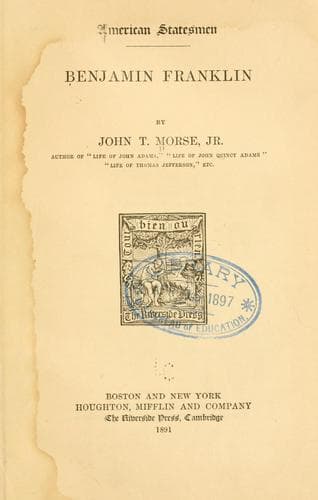
Benjamin FranklinMorse, John T., Jr. (John Torrey)
History
Benjamin Franklin
Morse, John T., Jr. (John Torrey)
Franklin, Benjamin, 1706-1790
But a fresh sensation was at hand. Horace and Thomas Walpole had
obtained private information of what had taken place in France, but had
cautiously held it in reserve, and arranged that only two hours before
the meeting of the House of Commons on that eventful day the Duke of
Grafton should tell it to Charles Fox. So now when North sat down Fox
rose, indulged in a little sarcasm on the conversion of the ministry to
the views of the opposition, and then asked his lordship "Whether a
commercial treaty with France had not been signed by the American agents
at Paris within the last ten days? 'If so,' he said, 'the administration
is beaten by ten days, a situation so threatening that in such a time of
danger the House must concur with the propositions, though probably now
they would have no effect.' Lord North was thunderstruck and would not
rise." But at last, warned that it would be "criminal and a matter of
impeachment to withhold an answer," he admitted that he had heard a
rumor of the signature of such a treaty.[52] So the bills were passed
too late.
[Note 52: Parton's _Life of Franklin_, ii. 309.]
So soon as their passage was assured, Hartley, "acting on an
understanding with Lord North,"[53] dispatched copies to Franklin.
Franklin upon his part, also first having an understanding with de
Vergennes, replied that, if peace with the States upon equal terms were
really desired, the commissioners need not journey to America for it,
for "if wise and honest men, such as Sir George Saville, the Bishop of
St. Asaph, and yourself were to come over here immediately with powers
to treat, you might not only obtain peace with America but prevent a war
with France." About the same time also Hartley visited Franklin in
person; but nothing came of their interview, of which no record is
preserved. The two bills were passed, almost unanimously. But every one
felt that their usefulness had been taken out of them by the other
consequences of that event which had induced their introduction. News of
them, however, was dispatched to America by a ship which followed close
upon the frigate which carried the tidings of the French treaties. If
the English ship should arrive first, something might be effected. But
it did not, and probably nothing would have been gained if it had.
Franklin truly said to Hartley: "All acts that suppose your future
government of the colonies can be no longer significant;" and he
described the acts as "two frivolous bills, which the present ministry,
in their consternation, have thought fit to propose, with a view to
support their public credit a little longer at home, and to amuse and
divide, if possible, our people in America." But even for this purpose
they came too late, and stirred no other response than a ripple of
sarcastic triumph over such an act of humiliation, which was aggravated
by being rejected almost without consideration by Congress.
[Note 53: Bancroft, _Hist. U. S._ ix. 485; Hale's _Franklin in
France_, i. 223.]
Public-domain text, read in full here on John Shaqi.
Reviews
Reviews
No reviews yet
Be the first to share your thoughts on this work.
Elsewhere in the archive
Join the Discussion
Join the discussion
Sign in to leave a comment or review.
Sign InorCreate an account