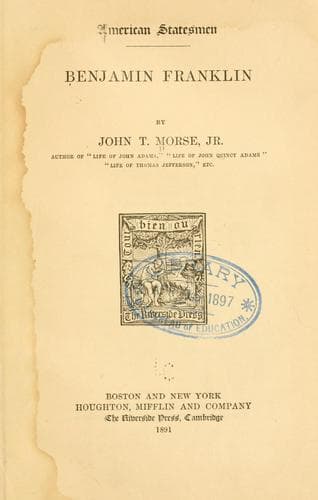
Benjamin FranklinMorse, John T., Jr. (John Torrey)
History
Benjamin Franklin
Morse, John T., Jr. (John Torrey)
Franklin, Benjamin, 1706-1790
Two methods of relief were then adopted, crude, simple, but likely for a
time to be efficient; and provided only that within that time the war
could be finished, all might go well. One of these methods was to issue
irredeemable paper "money;" the other was to borrow real money abroad.
The droll part was that both these transactions were audaciously entered
upon by a body which had absolutely no revenues at all to pledge as
security, which had not a dollar of property, nor authority to compel
any living man to pay it a dollar. A more utterly irresponsible debtor
than Congress never asked for a loan or offered a promissory note. For
the security of a creditor there was only the moral probability that in
case of success the people would be honest enough to pay their debts;
and there was much danger that the jealousies between the States as to
their proportionate quotas might stimulate reluctance and furnish
excuses which might easily become serious in so unpleasant a matter as
paying out hard cash. At home Congress could manage to make its paper
money percolate among the people, and could pay a good many American
creditors with it; but there were some who would not be thus satisfied,
and few European creditors, of course, would meddle with such currency.
So to pay these people who would have real money Congress solicited
loans from other nations. It was like the financiering of a schoolboy,
who issues his IOU's among his mates, and refers the exacting and
business-like tradesman to his father. France was cast for the role of
father to the congressional schoolboy for many wearisome years.
The arrangement bore hard upon the American representatives, who, at
European courts and upon European exchanges, had the embarrassing task
of raising money. It was all very well to talk about negotiating a loan;
the phrase had a Micawber-like sound as of real business; but in point
of plain fact the thing to be done was to beg. Congress had a
comparatively easy time of it; such burden and anxiety as lay upon that
body were shared among many; and after all, the whole scope of its duty
was little else than to vote requisitions upon the States, to order the
printing of a fresh batch of bills, and to "resolve that the Treasury
Board be directed to prepare bills of exchange of suitable denominations
upon the Honorable Benjamin Franklin [or sometimes Jay, or Adams, or
another], minister plenipotentiary at the court of Versailles, for----
thousand dollars _in specie_." Having done this, Congress had fulfilled
its simple part, and serenely waited for something to turn up.
Public-domain text, read in full here on John Shaqi.
Reviews
Reviews
No reviews yet
Be the first to share your thoughts on this work.
Elsewhere in the archive
Join the Discussion
Join the discussion
Sign in to leave a comment or review.
Sign InorCreate an account